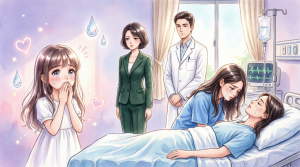
Part 11
Grandpa Henry died when Layla was eleven.
Peacefully, people said. In his sleep, they said. Both were true, but grief does not become gentle just because death behaves politely.
He had been reading in his chair the night before, glasses low on his nose, one hand resting on the arm where Layla had taped a sticker that said Best Fixer. In the morning, Grandma found him with the lamp still on and his book open against his chest.
The house changed sound after that.
Every old floorboard creak seemed to ask for him. Every tool in the garage looked paused mid-thought. Layla moved through rooms quietly for weeks, touching things he had fixed: the banister, the kitchen drawer, the crooked birdhouse outside.
At the funeral, my parents did not come.
Jason did not come.
I do not know if they were told. I did not ask. Grandma did not mention them, and neither did I.
The church was full anyway. Neighbors. Old coworkers. Nurses from the hospital. Lisa. Tasha. People Grandpa had helped with taxes, gutters, stubborn lawn mowers, and stubborn grief.
Layla stood beside me in a navy dress and read a short note she had written.
“My great-grandpa taught me that if something is broken, you should look closely before throwing it away. But he also taught me some things are not safe to keep. I think he was talking about chairs and people.”
Half the church cried.
Grandma laughed through tears and whispered, “That child is mine.”
After the service, Grandma handed me a small wooden box Grandpa had left.
Inside was a measuring tape, his old pocketknife with the blade removed for safety, and a letter.
For Layla when she is older.
She read it at thirteen, sitting on Grandma’s porch.
He wrote about soup in hospital thermoses, duck voices, and how brave she was before she knew the word. He wrote that family is not who makes claims on you when they need something, but who comes when you have nothing to give.
Layla folded the letter carefully.
“I miss him,” she said.
“Me too.”
“He came.”
“Yes.”
She held the letter against her chest.
“That matters.”
It did.
Grandma lived with us part-time after Grandpa died. She insisted she was not moving in, merely “redistributing her presence.” Her house remained hers, but more and more of her sweaters appeared in our guest room. Layla loved it. I did too.
The trust continued, now simpler and sadder. Lawrence helped with everything. Grandma remained organized in grief, which meant she labeled folders while crying and yelled at insurance representatives with perfect manners.
One autumn afternoon, she called me into the kitchen.
“I want to update one thing,” she said.
She slid a document across the table.
It was not about money.
It was a statement.
A written history of why my mother, father, and Jason had been removed from the estate. Dates. Incidents. The hospital. The fraud attempts. The property neglect. The impersonation. The no-contact orders. Clear, factual, notarized.
“I don’t want anyone rewriting this after I’m gone,” she said.
My throat tightened.
“Grandma.”
“No.” Her voice softened, but her eyes stayed sharp. “People like your mother survive by making fog. I am leaving you a lighthouse.”
I signed as witness.
Years later, that document would matter.
But not yet.
For a while, we simply lived.
Layla entered high school. She ran track badly but happily. She joined the debate team and became terrifying at dinner arguments. She wanted to become a pediatric respiratory therapist for about six months, then a lawyer, then a marine biologist, then maybe all three if scheduling allowed.
Grandma Ruth attended everything.
She sat in bleachers with a thermos of tea. She clapped at debates even when clapping was not encouraged. She corrected referees under her breath. She called Layla “little miss” until Layla was taller than both of us.
When Layla was sixteen, she asked to read the full file.
Not all of it, I said at first.
Then I looked at her.
She had her own mind. Her own instincts. Her own right to the truth of her life.
So we read it together over several nights.
The texts. The loan attempts. The hospital billing report. The eviction documents. The estate removal statement. Not every ugly voicemail, but enough.
She cried once.
Not when she read about being ignored in the hospital.
When she read Mom’s first text asking for Jason’s honeymoon money.
“Five thousand dollars,” she said, voice shaking. “While I was there?”
“Yes.”
She wiped her face roughly.
“I don’t want to know them.”
“I know.”
“I mean ever.”
“I know.”
“Not even if they’re sorry someday.”
I looked at my daughter, no longer little, still mine.
“Late sorry does not create a debt.”
She nodded.
“Good.”
Grandma, listening from the living room, called out, “Put that on a pillow.”
Layla laughed through tears.
That was our family.
Truth, tears, and someone in the next room refusing to let sorrow take itself too seriously.
Grandma Ruth died the summer after Layla graduated high school.
She held on long enough to see the ceremony, to watch Layla cross the stage with honors cords and a grin so wide it looked like sunrise. Three weeks later, she passed in her own bed with me holding one hand and Layla holding the other.
Her last clear words were to Layla.
“Remember who came.”
Layla whispered, “I will.”
After the funeral, Lawrence called.
My parents had contacted him.
Of course they had.
They wanted to contest the trust.
And for the first time in years, instead of fear, I felt Grandpa and Grandma’s lighthouse switch on behind me.
Part 12
The trust challenge lasted exactly forty-one days.
That sounds longer than it felt. Or maybe shorter. Grief made time strange. Layla was packing for college, Grandma’s house smelled like lemon oil and old books, and every drawer I opened seemed to contain some note she had left for a future I did not want to enter without her.
My parents chose that moment to come back.
Not to mourn.
To claim.
Their attorney sent a letter suggesting Grandma Ruth had been manipulated in her later years. It implied I had isolated her, influenced her, and benefited unfairly from “family conflict.” Jason submitted a statement claiming Grandma had always intended the estate to support the whole family and that I had “taken advantage of a medical crisis to turn everyone against him.”
Medical crisis.
My daughter’s ICU stay had become a legal phrase in my brother’s mouth.
I sat in Lawrence’s office with Layla beside me, her college orientation folder sticking out of her backpack. The room smelled the same as it had years earlier: leather, peppermint tea, paper.
Lawrence read the claims with an expression of professional boredom.
Then he opened Grandma’s notarized statement.
“This,” he said, “is why your grandmother was my favorite client.”
The challenge collapsed under documentation.
Fraud alerts. Hospital records. Police reports. Protective orders. Property neglect inspections. Eviction notices. Grandpa’s signed statements before his death. Grandma’s written history after it. Years of clean trust management. No ambiguity. No fog.
At the final meeting, my parents attended by video.
I had not seen them in years except for that grocery aisle glimpse. Mom looked older in a way that did not soften her. Dad’s face had settled into permanent grievance. Jason appeared from a separate screen, wearing a collared shirt and the same entitled expression he had worn on Grandma’s porch.
Amber was gone from the picture.
Lawrence explained that the trust was valid, the removals were valid, and further challenge would likely expose them to legal fees they could not afford.
Mom interrupted. “Jane, please. This is your family.”
I looked at her face on the screen.
Once, that sentence would have reached into my chest and pulled strings attached to childhood. Family. The magic word. The trapdoor. The leash.
Now it sounded like a language I no longer spoke.
“My family is sitting next to me,” I said.
Layla took my hand under the table.
Jason scoffed. “You’re really going to keep everything?”
I looked at him.
“No,” I said. “I’m going to protect everything Grandma and Grandpa protected from you.”
Dad leaned toward his camera. “You’ve become cold.”
“No,” Layla said.
Everyone went still.
She had not planned to speak. I felt it in the way her hand tightened around mine.
Layla looked directly at the screen.
“My mom became safe.”
My mother’s face changed.
For a moment, she looked almost human. Almost wounded by something real.
Then she said, “Layla, sweetheart, you don’t know the whole story.”
Layla’s hand stayed steady in mine.
“I know who came to the hospital,” she said. “And I know who asked for money.”
Silence.
Jason looked away first.
The meeting ended soon after.
No apology. No reconciliation. No dramatic collapse. Just a legal door closing with a soft, final click.
That evening, Layla and I went to Grandma’s house.
Our house now, technically. But I still called it Grandma’s. Maybe I always would.
We sat on the porch where mint still grew in coffee cans, though less neatly without her hands tending it. The sunset turned the yard gold. Crickets sang from the grass. Across the street, a child rode a scooter in uneven circles while his father clapped.
Layla leaned her head against my shoulder.
“Do you feel bad?” she asked.
“About what?”
“Keeping it all.”
I thought carefully.
“No.”
“Good.”
“Do you?”
“No.” She sat up and looked at the house. “They left us with machines and bills and fear. Grandma and Grandpa left us with soup, blankets, and a place to stand. I know which inheritance matters.”
I laughed softly. “You sound like Ruth.”
“Highest compliment.”
We stayed there until the porch light came on automatically.
College move-in came two weeks later. Layla chose a school three hours away with a strong biology program and dorm rooms too small for the number of plants she insisted on bringing. We packed the car with bins, bedding, snacks, shower shoes, and the stuffed dog from the hospital.
“You’re taking him?” I asked.
She held him up. His floppy ear was more worn than ever.
“Obviously. He has emotional support experience.”
The drive was full of nervous chatter and bad radio. At the dorm, we carried boxes up two flights of stairs in humid August heat. Her roommate arrived with fairy lights and a mother who cried openly while making the bed. Layla introduced me proudly, not as a burden, not as a cautionary tale, but as her mom.
When it was time to leave, she hugged me hard.
“I’ll call tonight,” she said.
“You don’t have to call tonight if you’re busy.”
“I know. I’m calling anyway.”
I held her face in my hands.
“Remember who came,” I said.
Her eyes filled, but she smiled.
“I do.”
I cried in the car on the way home.
Not the way I cried in the hospital. Not abandoned. Not terrified. This was the grief of a child growing exactly as she should, away from me but not out of reach.
When I got back to Grandma’s house, the rooms were quiet. Sunlight fell across the kitchen table. On the counter sat the blue notebook Grandma had used during the hospital days, the one with names, times, confirmation numbers, proof.
I opened it to the first page.
At the top, in her handwriting, she had written:
Jane and Layla: protect first, explain later.
I touched the words.
Then I placed the notebook in the fireproof lockbox with the trust papers, Grandpa’s letter, and the hospital photo of Layla sleeping with the stuffed dog.
Not because I wanted to live inside the past.
Because the past had finally learned its place.
Years ago, my daughter fought for breath while my phone stayed silent. Two days later, my mother asked me for five thousand dollars for my brother’s honeymoon. That text ended the old version of my life.
I lost parents who never came.
I lost a brother who never cared.
I lost the illusion that being useful would make me loved.
But I gained the truth. I gained my grandparents back. I gained a home built on protection instead of obligation. Most of all, I gained the kind of motherhood that my daughter could stand inside without fear.
My mother once thought silence meant I would come around.
She was wrong.
Silence became the space where Layla and I healed.
And in that space, with the right people finally around us, we became a family no one could use, erase, or abandon again.
THE END.

