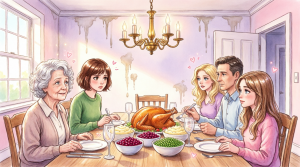
My family laughed when I asked if Grandma still needed the $1,500 from my Marine pay, but the second she set down her fork and said, “Do the math,” the whole Thanksgiving table went silent.
The fork stayed suspended in Grandma Clara’s hand for one sharp, impossible second.
Steam curled off the sweet potatoes.
Somebody’s chair creaked.
Outside, kids in the neighborhood were still setting off leftover firecrackers from some early holiday celebration, but inside that dining room every sound seemed to pull back from the table and wait.
I had seen people freeze under pressure before.
I had worked long enough as a Marine medic to recognize the difference between surprise and fear.
Surprise is fast.
Fear goes still.
My sister Amelia gave me the same superior little smile she had worn since high school, the one that said I was about to embarrass myself in front of everyone again.
My father leaned back like he had front-row seats to a joke.
My mother pinched her wineglass between two fingers and looked at me with the exhausted irritation she saved for moments when I disrupted the version of the family she preferred.
I had spent six years being the child they did not know how to present.
I was too blunt for their church friends, too independent for their expectations, too far away to be useful except as a story they could edit.
I was twenty-four, unmarried, usually stationed somewhere humid or hard, and I had built a life around work that demanded stamina instead of charm.
I had learned how to stabilize a stranger while my own knees shook.
I had learned how to eat in ten minutes, sleep in pieces, and carry grief without letting it make my hands unsteady.
And every month, no matter where I was, I sent $1,500 home.
I sent it because Grandma Clara was eighty, because my parents had told me her roof leaked and her prescriptions kept getting more expensive, and because she was the one person in that family who had never spoken to me like I was some temporary inconvenience.
When I was a kid and the rest of the house felt judgmental and narrow, Grandma had made me grilled cheese at midnight and told me there was nothing wrong with a girl who wanted more than the room she was born in.
That mattered enough for me to send the money without keeping score.
When I came back to Baton Rouge for Thanksgiving and Grandma’s eightieth birthday, I had hoped for a small, decent homecoming.
I did not need praise.
I did not need anyone to call me a hero.
I only wanted my mother to hug me like she had missed me, my father to ask one sincere question, my siblings to look at me like I still belonged in the photograph.
Instead, my mother spent the first ten minutes talking about Lucas’s classes, Lucas’s internships, Lucas’s summer abroad application.
My father looked up from his phone just long enough to say, “Look who finally remembered where home is.” Amelia stared at my duffel bag like it was offensive.
Nobody asked about Guam.
Nobody asked what six years in uniform had done to my sleep, my shoulders, or the part of me that no longer relaxed when
doors slammed.
The house looked worse than the people.
Water stains spread across the hallway ceiling.
The den smelled damp.
A baseboard near the kitchen was soft with rot.
Grandma’s cardigan hung looser on her shoulders than it used to.
She moved more carefully too, as if every step had to be negotiated with her hips.
That was what pushed the question out of me.
I looked at the stain above the dining room doorway and asked, as gently as I could, “Grandma, is the $1,500 from my military pay still enough for the roof and your medicine?”
My mother inhaled sharply.
Amelia muttered, “Seriously?” Dad said, “Danielle always needs a scene.” I almost apologized on instinct.
That is what years in a dismissive family teaches you.
You start feeling rude for noticing your own sacrifice.
Then Grandma Clara lowered her fork and said, “Steady as a shot.
She’s been sending that money every month for years.
Do the math.”
The table went silent.
Then Grandma frowned and asked, “Sending it where, baby?”
I told her what I had been told for years: that the money went to an account under her name because she did not use online banking and Dad handled the deposits for her.
She looked right at me and said, “Danielle, I do not have a bank account in my name.”
The air left the room.
My father missed his water glass the first time he reached for it.
My mother drank too fast.
Amelia stopped smirking.
Lucas looked from face to face like he had walked into the last five minutes of a conversation everyone else had been having for years.
Grandma sent my parents into her study.
The rest of us sat in the strange quiet that follows a truth too big to ignore.
I stared at my untouched food and thought about every transfer I had made from barracks rooms, aid stations, airport terminals, and bunk corners.
I had sent that money after eighteen-hour shifts.
I had sent it while half asleep.
I had sent it because I thought I was protecting the one person who had protected me.
An hour later, after voices rose and fell behind the study door, Lucas found me in the guest room.
His eyes were red.
He held a black USB drive in his hand like it might leave a mark.
“I found this in Dad’s desk last week,” he said.
“I thought it was school paperwork.
I didn’t know what it was until tonight.”
I believed him.
That made everything hurt in a different way.
I plugged the drive into my laptop.
Folder after folder opened.
Spreadsheets.
Statements.
Tuition invoices with Lucas’s name on them.
Receipts from Amelia’s boutique.
Past-due notices tied to one of Dad’s business accounts.
A budgeting document in Mom’s handwriting that categorized my monthly transfer as if it were just another household revenue stream.
Then I opened an email sent under my name, thanking someone for helping my brother “carry the family forward” while I served overseas.
That alone was enough to make my stomach turn.
Then I found the folder marked MONDAY_APPT.
Inside was a $28,000 personal loan application in my name, with my Social Security number, my military pay documents, and a signature line prepared for me.
There was also
a separate authorization form that would have allowed continued access to my military deposits.
The appointment was set for the Monday after Thanksgiving.
The money was not the end of it.
It was the foundation.
Grandma came into the guest room without knocking, still in her house slippers, Lucas trailing behind her.
I turned the laptop toward her.
She read every page slowly, one hand braced against the dresser.
She did not cry right away.
She got quiet first, which somehow felt worse.
By midnight the three of us were sitting on the bed with printed papers around us, adding totals.
Seventy-two transfers.
Six years.
One hundred eight thousand dollars.
It had not gone to a roof.
It had not gone to medication.
It had gone to Lucas’s tuition, his apartment deposit, his study-abroad fees, Amelia’s boutique charges, Dad’s business debt, credit card minimums, restaurant bills, and whatever else my parents had decided counted as family need.
Some months there were notes in Mom’s spreadsheet that made me feel physically cold: Danielle allotment cleared, use for Lucas; pull from Danielle transfer for Amelia; hold enough to show Grandma pharmacy receipt.
Grandma finally sat down hard in the chair by the window and pressed a hand to her chest.
“I skipped appointments,” she said quietly.
“Your mother said the medicine samples were fine and the roof could wait until spring.”
That sentence broke something open in me.
They had not only stolen from me.
They had let her go without while telling me I was helping.
When dawn came, Grandma was the one who decided what happened next.
She did not ask for peace.
She did not ask for privacy.
She told Lucas to bring every printed page to the dining room.
Then she called my parents and Amelia back to the table.
There is a particular terror in being confronted by paperwork.
People can deny feelings.
Numbers are less merciful.
My father came in first, jaw tight, still trying to look like authority would save him.
My mother looked swollen from crying.
Amelia hovered behind them, suddenly more interested in the floor than in me.
Lucas took a seat across from them instead of beside them.
Grandma rested both palms on the table.
“Tell me,” she said, “which one of you opened the account and which one of you decided my granddaughter was stupid enough never to ask questions.”
My mother started with the language of panic dressed up as justification.
Money had been tight.
Dad’s business had slowed down.
Lucas got into a private program and they did not want him to lose momentum.
Amelia needed help getting started.
They had meant to pay me back.
They had planned to fix the roof later.
It was temporary.
It was complicated.
It was for the family.
Dad took over when he thought the room might soften for him.
“You were doing okay,” he said to me.
“You always land on your feet.
We thought we could use it for a while and make it right when things stabilized.”
I slid the loan application across the table.
“Was identity theft part of the temporary plan?”
That was the first time Lucas made a sound.
“You used her Social Security number?” he asked, and the disgust in his voice cut through everything.
My mother looked at him like she could still gather him back to her side.
“It was for this house.
For all of us.”
“For me?” Lucas said.
“You stole from her for me?”
Dad’s answer was the ugliest thing he said all day because he sounded sincere.
“We were investing in the child with the future that would pay off.”
Nobody moved after that.
Not even Amelia.
I had spent years being treated like the difficult daughter, the one with the wrong edges, the wrong tone, the wrong life.
Hearing my father reduce me to the sturdy child who could absorb loss and still function explained more than I wanted explained.
They had not taken from me because I mattered least.
They had taken from me because they believed I would survive it quietly.
Grandma’s voice went low and steady.
“She was sending that money while sleeping in barracks and patching up strangers.
I was sitting under a leaking roof thinking I was being cared for.
And the whole time you were robbing the only child in this family who acted like love was a verb.”
Amelia finally spoke, weakly.
She admitted she had known Mom sometimes used “Danielle’s transfer” to cover things, but she claimed she thought it was only household expenses.
She had not known the amount.
She had not known about the loan.
Lucas looked sick.
He said he would cancel the study-abroad program that morning.
He said every benefit he had received through that money would be unwound if he had to do it one humiliating phone call at a time.
I went out to the porch with my phone and called the legal assistance office on base.
The attorney I reached told me exactly what I already knew in my bones: if I wanted my name cleared, this could not stay a private family mess.
I froze my credit.
I filed an identity theft report.
I preserved the USB and emailed copies to myself and to legal counsel.
Grandma signed a statement confirming she had never owned the account my parents claimed was hers.
Lucas gave a written statement too.
Before noon, Grandma called her attorney, Mr.
Thibodeaux, who had known our family longer than I had been alive.
He arrived with a leather folder and the kind of calm that terrifies guilty people.
He told my parents to surrender every password, every checkbook, every bank card tied to the fraudulent account.
On speakerphone, in front of all of us, he called the bank branch and canceled the Monday appointment.
What followed took months, but it did not stay murky.
The bank confirmed that the account receiving my transfers had been opened by my parents under a name designed to make it look connected to Clara.
The loan did not fund because we stopped it in time, but there had already been credit inquiries in my name and one small card opened using my information.
Because the paper trail was so clean, the sheriff’s fraud unit moved quickly.
My parents eventually pleaded guilty to reduced fraud charges rather than drag the evidence through a public trial.
Restitution became part of the sentence.
Money came back in ugly pieces.
The bank seized what remained in the account.
Lucas canceled the abroad program and the school
refunded part of the fees.
Dad sold his truck and a small rental lot he had been holding onto for years.
Mom emptied a retirement account.
Amelia sold inventory from the boutique and paid back what had been charged there.
It did not feel noble.
It felt overdue.
Grandma changed her will, her medical paperwork, and the locks on the house.
She removed both of my parents from every decision that involved her care.
She asked them to leave that weekend.
Amelia went with them.
Lucas stayed in Baton Rouge, transferred to an in-state program, got a part-time job, and started coming home every evening to help Grandma with groceries, prescriptions, and the thousand little tasks my parents had always claimed were exhausting.
The last conversation I had with my mother before I stopped answering was in Mr.
Thibodeaux’s office.
She cried and said she had only wanted to keep the family afloat.
She said she knew I was strong.
She said she thought I would understand once I saw the pressure they were under.
I told her that people always praise strength when they are looking for permission to exploit it.
Six months later, I came home on leave again.
This time rain was hitting a brand-new roof.
The hallway ceiling had been repaired and painted.
The house smelled clean instead of damp.
Grandma’s medications were lined up in a proper organizer on the kitchen counter, and Lucas was standing at the stove burning cornbread on purpose because he still had not learned that the timer exists for a reason.
Grandma looked stronger.
Not younger, not magically untouched, but steadier.
Safer.
That mattered more.
We ate at the same table where everything had cracked open.
The room felt different now, like the air had finally been forced to tell the truth.
There was no performance left in it.
No version of the family polished for public viewing.
The hardest part was never the money.
It was understanding the logic behind the theft.
My parents had watched me build a life on discipline, sacrifice, and endurance, and instead of respecting it, they treated it like a resource they were entitled to mine.
They did not admire my strength.
They budgeted around it.
Sometimes I still think about that Thanksgiving and wonder what the biggest red flag was—the laughter, the way nobody asked how I was, the water stain over the doorway, or the easy confidence with which they assumed I would keep loving without looking too closely.
I know this much now: some betrayals do not arrive screaming.
Some sit down to dinner, pass the rolls, and wait for the quietest person at the table to notice the math.
And once I did, nothing under that roof was ever allowed to lie comfortably again.
THE END

