At 10:11 on Sunday morning, the first motion alert lit up my phone. Front driveway. I was standing inside my grandmother Elaine’s kitchen with a mug of coffee I had not touched. The house was quiet except for the hum of the refrigerator and the faint tick of the wall clock she used to wind every Friday. Cold light came through the lace curtains and cut the floor into pale rectangles.
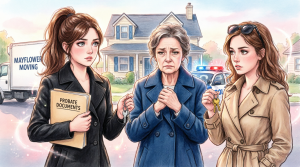
On my phone screen, a white moving truck backed into the driveway.
Behind it came my mother’s SUV.
Then Stephanie climbed out holding a set of keys.
She looked exactly like someone arriving to collect something already promised to her. Cream coat. Oversized sunglasses. Hair blown straight. One hand lifted toward the movers like she was directing staff at a charity gala.
My mother got out next, tight-lipped and composed, her purse tucked under her arm.
My father came last.
That was what bothered me most.
He had always preferred to let my mother do the cutting, then step in afterward with a tired voice and call it a misunderstanding.
But he was there.
That meant they expected a clean transfer.
They expected me to fold.
Two days earlier, my mother had called while I was leaving Boston Housing Court. I still had the smell of old paper and courthouse coffee clinging to my coat. My feet hurt from standing through a landlord-tenant hearing that had dragged past lunch, and my head throbbed from fluorescent lights.
She did not ask how I was.
She did not soften her voice.
“You have two days to clear out,” she said.
I stopped beside a concrete planter outside the courthouse.
“What?”
“That house is Stephanie’s now.”
Traffic dragged past in the street. Somewhere behind me, a man laughed too loudly into his phone. My own hand went still around mine.
That house had never been just walls.
It was Elaine’s house outside the city, the one with blue shutters and a porch that wrapped around like open arms. In summer, the boards smelled like sun-baked paint. In winter, the windows rattled when the wind came down from the trees. Elaine kept peppermints in a blue glass dish by the sink and always wore flour on one sleeve.
My parents visited that house like guests.
I lived there every weekend I could.
Elaine taught me to sand porch rails, read utility bills, plant hydrangeas, and keep copies of anything important. She used to tap legal envelopes with one crooked finger and say, “Love people, Claire. But never make memory do the work of paper.”
When she died, her will was clear.
The house went to me.
Not to my mother.
Not to Stephanie.
Not to “the family.”
To me, fully and directly, with no conditions.
My mother called that unfair. Stephanie called it emotional manipulation. My father called it something Elaine must have done while confused, although he had not sat with her through one chemo appointment or one late-night oxygen scare.
I had.
For three years, I handled repairs, pharmacy runs, property taxes, insurance renewals, and the quiet terror of watching a strong woman shrink inside her own cardigan.
After probate closed, I paid the $14,900 roof replacement. I changed the boiler. I kept the gutters clean. I kept Elaine’s roses alive.
Stephanie posted photos from the porch every Thanksgiving and tagged herself as “home.”
That was her contribution.
So when my mother said the house was Stephanie’s now, I did not argue.
I did not explain the law to someone who had already decided family pressure outranked it.
I said, “Okay.”
Then I hung up.
At 7:04 p.m., I pulled the gray fireproof box from under my bed. The latch scraped. The metal was cold under my fingers.
I laid everything across my kitchen table.
Certified deed.
Probate order.
Elaine’s will.
Tax records.
Homeowner’s insurance.
Utility statements.
Receipts for repairs.
A copy of the letter Elaine had written to the attorney after Stephanie tried to pressure her into changing the will the first time.
That last document was the one my family had always pretended did not exist.
I read it twice.
Then I called Marisol Vega, an estate attorney I knew from court.
Marisol listened without interrupting. I could hear papers shifting on her end and the faint clink of a spoon against a mug.
When I finished, she said, “Do not let them inside.”
“I wasn’t planning to.”
“No, Claire. I mean not even to look around. Not even for five minutes. Not even if they cry. The second they establish any physical access, they’ll turn this into a story about possession and family permission.”
My throat tightened.
“What mistake costs me the most?”
“Opening the door.”
So I did not.
Saturday morning, I drove to the house with storage bins, a notebook, and my whole body wired tight. The air smelled like damp leaves and old rain. My tires crunched over gravel. When I unlocked the front door, the house gave its familiar sigh, hinges creaking, heat clicking somewhere in the walls.
For a moment, I stood in the entryway and saw Elaine everywhere.
Her straw hat still hung on the peg near the pantry.
A tiny chip still marked the kitchen tile where I dropped a cast-iron pan at fourteen.
The porch swing still leaned slightly to the left because my father once promised to fix it and never did.
I started with the irreplaceable things.
Photo albums.
Elaine’s wedding band.
Her recipe box.
The blue ribbon bundle of letters from my grandfather.
Her handwritten ledger of repairs.
Then I moved to what mattered legally.
I photographed every room.
I photographed the locks.
I photographed the windows, the basement door, the garage, the mailbox, the fuse panel, and the meter.
At 12:43 p.m., the locksmith arrived. He was an older man named Dennis with wind-reddened cheeks and careful hands. He changed the front lock, back lock, porch door, and garage entry.
“Family trouble?” he asked, not looking up.
“Something like that.”
He gave me three new keys sealed in a paper sleeve.
“Then keep the receipt.”
I did.
At 2:10 p.m., I called the local police non-emergency line. I explained that relatives had threatened to remove me from a property I legally owned and might arrive with movers. I offered to email proof of ownership.
The dispatcher’s voice stayed neutral.
“If they come, call us immediately. Do not engage physically. Stay outside if safe.”
At 3:35 p.m., Stephanie texted.
Can you leave the curtains? The dining room ones are perfect.
At 3:42 p.m., she sent another.
Also don’t take the hall mirror. It fits my aesthetic.
At 4:01 p.m., my mother left a voicemail.
“Claire, don’t make this ugly. Stephanie has already made arrangements. You know how anxious she gets when plans change.”
I listened once while standing in Elaine’s pantry.
The shelves smelled faintly of cinnamon, old paper bags, and lemon oil.
Then I saved the voicemail.
My father’s email came at 9:22 p.m.
Do what’s right for the family.
I printed it and placed it behind the deed.
By Sunday morning, I had the folder ready.
Not a messy pile.
Not emotional evidence.
A clean sequence.
First: deed.
Second: probate order.
Third: certified will.
Fourth: tax records.
Fifth: locksmith receipt.
Sixth: my mother’s voicemail transcript.
Seventh: Elaine’s letter.
The letter was the blade under the cloth.
I watched Stephanie on the security feed walk toward the front door with two movers behind her. One carried folded blankets. Another rolled an empty dolly down the ramp.
The metal wheels rattled across the driveway.
Stephanie lifted the key ring.
“This won’t take long,” she told them.
I stepped out through the side door before she reached the porch.
The air bit my cheeks. The folder was firm under my arm. Somewhere nearby, a crow called from the maple tree.
Stephanie did not see me at first.
She pushed a key into the front lock.
It stopped.
She tried again.
The key scraped uselessly.
Her smile held for one second too long.
Then her neck went red.
My mother came up behind her.
“Try the old brass one.”
“I am.”
My father looked toward the street, already uncomfortable.
Stephanie twisted harder.
The lock did not move.
I walked to the edge of the driveway.
“Morning,” I said.
Stephanie spun around.
For the first time all weekend, she looked unsure.
My mother recovered faster.
“Open the door, Claire.”
“No.”
The word was small. It landed anyway.
One of the movers looked between us.
My mother’s voice stayed low and polished.
“Don’t embarrass yourself in front of strangers.”
I looked at the truck.
“Did they tell you they own this house?” I asked the movers.
The man with the dolly shifted his grip.
Stephanie laughed once, sharp and thin.
“She’s being emotional. It’s a family transfer.”
“No,” I said. “It’s not.”
That was when the patrol car turned the corner.
It did not arrive with sirens. It eased to the curb, quiet and steady, like the end of an argument no one else realized had already been decided.
My father took one step back.
My mother’s eyes flicked to me.
Stephanie lowered the key ring.
An officer stepped out. Mid-40s, square shoulders, calm expression. His badge caught the gray daylight.
“Who called about a property dispute?”
“I did.” I lifted the folder.
My mother moved first.
“Officer, this is a family matter. My daughter is having difficulty accepting—”
He held up one hand.
“Ma’am, I’ll speak to everyone separately if needed. Documents first.”
I handed him the folder.
My hands did not shake until after he took it.
He opened the deed. Read the first page. Checked the address. Checked my ID. Turned to the probate order.
The movers stood silent now.
A neighbor across the street had come halfway down her porch steps with a coffee mug in both hands.
Stephanie’s sunglasses were still on top of her head, but her eyes had changed. The confidence had thinned into calculation.
“Mom,” she whispered, “tell him.”
My mother’s mouth tightened.
The officer looked up from the probate order.
“Ma’am,” he said to my mother, “who told you this property belonged to your daughter?”
“She’s histrionic,” my mother said.
It was such an old word in her mouth. One she used whenever I refused to make her comfortable.
The officer did not blink.
“That wasn’t my question.”
Stephanie tried to smile.
“Our grandmother wanted me to have it. Claire knows that.”
I said nothing.
The officer turned another page.
“This order says otherwise.”
My father cleared his throat.
“There was an understanding.”
The officer looked at him.
“Is that understanding recorded in any legal document?”
No one answered.
Then the second car pulled up behind the patrol unit.
A black sedan.
Marisol stepped out in a charcoal coat, hair pinned low, leather briefcase in one hand. She walked up the driveway like she had never wasted a step in her life.
Stephanie’s face changed before Marisol said a word.
Because Stephanie recognized her.
Years earlier, after Elaine’s first fall, Stephanie had tried to get Elaine to sign a “temporary management authorization” over the house. Elaine had refused. Then she had called Marisol.
Marisol had kept the letter.
My mother saw the briefcase and went pale around the mouth.
“Claire,” she said softly, “this is unnecessary.”
That softness was more dangerous than anger.
Marisol stopped beside me.
“Officer, I’m Marisol Vega, counsel for Claire Whitman regarding this property. I have a certified copy of the deed, probate file, and a prior written statement from Elaine Whitman documenting attempted undue influence by Stephanie Whitman.”
Stephanie’s lips parted.
“What?”
Marisol removed the document from her briefcase.
Elaine’s signature sat at the bottom in blue ink.
I knew every bend of it.
My grandmother had written that Stephanie pressured her while she was recovering from treatment. She had written that Stephanie told her Claire was “too sentimental” to manage property. She had written that she wanted no ambiguity after her death.
The officer read silently.
A truck engine idled behind us.
Somewhere on the porch, the old wind chime tapped once against the railing.
Stephanie took one step toward Marisol.
“That was private family conversation.”
Marisol looked at her.
“It became evidence when you arrived with a moving truck.”
My mother reached for my father’s arm. He did not look at her.
The officer closed the folder halfway.
“Based on these documents, Ms. Claire Whitman appears to be the legal owner. You do not have permission to enter or remove property. If you attempt to enter, it may be treated as trespassing.”
Stephanie’s face went blotchy.
“This is insane. She manipulated Grandma.”
I finally looked at her fully.
For years, I had answered her. Defended myself. Explained myself. Tried to make her understand love was not a pie chart.
That morning, I did not give her a courtroom.
I gave her silence.
The mover with the dolly turned to Stephanie.
“Ma’am, we can’t proceed without proof you’re authorized.”
“We are authorized,” she snapped.
“Not by the owner,” he said.
My mother turned on me then, still quiet, still polished.
“You would humiliate your sister over a house?”
The porch boards creaked in the wind.
I thought of Elaine’s hands guiding mine on a paintbrush. Elaine at the kitchen table, oxygen tube under her nose, still asking whether I had eaten. Elaine telling me to keep the house steady.
“No,” I said. “You humiliated her by thinking her will was optional.”
My father flinched.
It was the only honest thing he did all morning.
Marisol handed Stephanie a notice. Not dramatic. Not theatrical. A single clean page.
“Any further attempt to enter, remove property, harass Ms. Whitman, or misrepresent ownership to third parties will be documented for civil action.”
Stephanie stared at the paper.
Her fingers did not close around it.
So it slid slightly in the wind and tapped against her coat.
My mother picked it up instead.
The officer remained beside the walkway.
“Truck needs to leave the driveway,” he said.
No one moved.
Then the neighbor across the street lifted her phone.
Stephanie saw it.
That was when her posture broke.
Not completely. Stephanie never collapsed where people could see.
But her chin lowered. Her mouth tightened. Her hand, still holding the useless key ring, dropped to her side.
One by one, the movers loaded their blankets back into the truck.
The dolly rattled up the ramp.
The sound was ordinary.
That made it worse.
My mother stood beside her SUV, reading Elaine’s letter with eyes that moved too fast. My father stared at the house as if seeing it for the first time.
Stephanie turned to me.
“You planned this.”
I looked at the folder under the officer’s arm, the changed lock, the porch Elaine loved, the brass key that no longer opened anything for them.
“No,” I said. “Elaine did.”
For a few seconds, nobody spoke.
Then Marisol leaned slightly toward me.
“The next step is yours.”
I nodded.
Because the house was safe.
But the story was not finished.
By Monday at 8:30 a.m., Marisol filed a formal cease-and-desist. By noon, the moving company emailed me a copy of Stephanie’s booking request, including her written claim that she was “the new legal owner.” By 2:15 p.m., my mother left a voicemail saying she hoped I was proud of myself.
I saved that too.
At 5:40 p.m., I sat at Elaine’s kitchen table with the documents stacked in front of me and her old blue glass peppermint dish beside my elbow.
The house smelled like lemon cleaner and old wood.
For the first time all weekend, I drank my coffee while it was still warm.
Then I opened a new folder on my laptop.
I named it: Whitman Trespass Attempt.
And I started with the video of Stephanie smiling at the door, holding a key that no longer worked.

