My 15-year-old daughter had been complaining of nausea and stomach pain for weeks.
My husband said, “She’s just faking it.
Don’t waste time or money.” I took her to the hospital in secret.
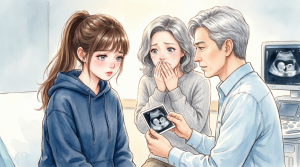
The doctor looked at the image and whispered, “There is something inside her…” I couldn’t do anything but scream.
I knew something was wrong long before the hospital confirmed it.
Mothers learn the language of small changes.
We hear the difference between a tired sigh and a frightened one.
We notice when a laugh disappears from the house and does not come back.
Hailey had always been bright in ways that filled a room without trying.
She was the girl who set alarms for sunrise soccer practice and still had energy afterward to take photos of dew on the grass.
She talked with her hands.
She stole fries off my plate and called it a victimless crime.
She edited pictures late into the night and pinned printed snapshots on the wall above her desk.
Then, over a few weeks, she began shrinking right in front of me.
She said her stomach hurt.
Then she said she felt nauseated all the time.
Then came the dizziness, the exhaustion, and a strange heaviness in her body that made her move like she was carrying something invisible.
She stopped asking to see friends.
She stopped finishing meals.
She slept with her curtains closed and her phone face down.
Even her voice changed.
Everything in her sounded muted, like life had turned down its own volume.
Mark dismissed it from the start.
“She’s fifteen,” he said one evening, scrolling on his phone while I stood at the kitchen counter, barely touching my own dinner.
“Teenagers collect symptoms like hobbies.
You take her to one doctor, and suddenly we’ll be paying for ten.
She’s dramatic, Laura.
Let it pass.”
I wanted to argue, but Mark had a way of flattening every concern with a few clipped sentences.
He made worry sound irrational and care sound expensive.
If I pushed, he accused me of making Hailey weak.
If I insisted, he called it panic.
He never raised his voice much.
He did not need to.
He could freeze a room with calm contempt.
Hailey heard it all.
Every time I asked her in front of him how she was feeling, she retreated further.
She would pull her hoodie over her head and say, “I’m fine.” Once, I saw her flinch before he even answered for her.
Then I found the hair in the bathroom sink.
It was not a few strands.
It was a small tangled clump, the kind that makes your stomach drop before your brain can explain why.
I called her name.
She appeared in the doorway with her hood up, one hand half-hidden in the sleeve.
“Did you brush too hard?” I asked.
“I guess,” she said quickly.
She did not meet my eyes.
That night I told Mark I was taking her to a doctor whether he approved or not.
He actually laughed.
“You are feeding this,” he said.
“The more attention you give her, the worse she’ll get.
She wants a reaction.
Stop giving her one.”
I looked toward the hallway and saw Hailey standing there for just a second before she disappeared back into her room.
should have followed her right then.
I should have walked out of the house with her that night.
Instead, I stayed up listening to every creak in the floorboards, every rustle behind her bedroom door, and hating myself for hesitating.
After midnight, I opened her door and found her curled into herself, gripping her stomach with both arms.
Her face was nearly gray.
Sweat clung to her hairline.
Her pillow was wet with tears.
“Mom,” she whispered, “please make it stop.”
The next afternoon, while Mark was at work, I took her to St.
Helena Medical Center.
The waiting room was bright in that aggressive hospital way that makes everything feel more exposed.
Nurses took blood.
A resident asked gentle questions.
An ultrasound technician rolled cold gel over Hailey’s stomach and went silent halfway through.
I saw her expression change.
She moved the wand again and again, then left to get the doctor.
Dr.
Adler came in with a folder tucked against his chest.
He lowered his voice and said the image showed something inside Hailey’s stomach.
I felt my lungs fail for a second.
When I asked what that meant, he said he needed a CT scan right away and told me, very carefully, that this was serious.
I screamed.
I did not mean to.
The sound just tore out of me.
A nurse rushed to the door.
Hailey grabbed my wrist with freezing fingers and whispered, “Mom…
please don’t call Dad.”
Those were the words that changed everything.
The CT scan moved quickly after that.
Within an hour, Dr.
Adler was back.
He shut the door and pulled a stool close to us.
“This is not a pregnancy,” he said, as if he knew that fear had already crossed my mind.
“It is a large mass in her stomach.
Based on the shape and density, I believe it’s a trichobezoar.” He paused when my face told him I had no idea what that was.
“A compacted mass of swallowed hair.
In Hailey’s case, it appears to extend beyond the stomach into the small intestine.
We sometimes call this Rapunzel syndrome.
It’s rare, and it can become life-threatening.”
I turned to my daughter so fast I nearly fell out of my chair.
Hailey was crying before I could even speak.
Dr.
Adler asked gently, “Have you been pulling your hair out, Hailey? Or swallowing it?”
With shaking hands, she pushed her hood back.
I saw the patches then.
A thin place near her temple.
Broken strands near her crown.
Areas she had arranged carefully every morning and hidden every afternoon.
My stomach twisted with a different kind of pain, the kind that comes when you realize your child has been suffering in a language you failed to understand.
“We need surgery tonight,” Dr.
Adler said.
“The mass is too large to pass on its own, and it’s already causing significant obstruction.
If we wait much longer, we risk a perforation or a full blockage.”
The room blurred around me.
Consent forms appeared.
Nurses explained anesthesia.
Someone attached a bracelet to Hailey’s wrist.
Someone else asked about allergies.
I answered automatically, like a person speaking from underwater.
Then Hailey clutched my hand and said, very softly, “He knew.”
I bent closer.
“What do you mean?”
Her mouth trembled.
“Dad saw
me once.
Months ago.
I was in the bathroom.
He told me if I ever told anyone, they would think I was crazy.
He said I was doing it for attention.
He said if I made you spend money on doctors, he’d never forgive me.”
For a second I could not process the sentence.
It did not fit into the shape of the man I had been trying to defend in my own head for years.
Then it fit too well.
The nurse took Hailey toward pre-op.
I kissed her forehead and promised I would be there when she woke up.
She looked terrified, but beneath that terror was something else: relief.
It hit me with brutal force that my daughter felt safer going into surgery than going home and facing her father.
I was in the waiting room signing one last form when Mark arrived.
The hospital had called the emergency contact listed on Hailey’s chart.
He came in angry, not scared.
His tie was loosened from work, his jaw clenched, his eyes already looking for someone to blame.
“You took her here behind my back?” he demanded.
“She needs emergency surgery,” I said.
He stared at me.
“For what?”
I heard how absurd the answer would sound before I said it.
“They found a mass made of swallowed hair.
It’s blocking her stomach.”
For the first time, he looked unsettled.
But it lasted only a second.
“So she did this to herself,” he said.
Those six words split something open in me.
Not Is she okay.
Not What can I do.
Not How did we miss this.
So she did this to herself.
I looked at him and saw, all at once, the structure of the last few years.
The way Hailey always went silent after he criticized her.
The way she hid when he was in a bad mood.
The way he dismissed pain, sadness, fear, and need as weakness.
The way I had mistaken emotional cruelty for strictness because it arrived in such controlled packaging.
The surgery lasted a little over three hours.
Those were the longest three hours of my life.
Every time the waiting room doors opened, I stopped breathing.
Mark paced for a while, then sat across from me in brittle silence, as if this were an inconvenience that had happened to him.
Dr.
Adler finally came out still wearing a cap and mask around his neck.
He looked tired, but relieved.
“She did well,” he said.
“We removed the mass successfully.
It was large and extended from the stomach into the intestine, exactly as the scan suggested.
Another week or two, and this could have been far worse.”
I sat down because my legs would not hold me.
Mark asked only one question.
“How long will she be in the hospital?”
Dr.
Adler’s expression changed almost imperceptibly.
He answered him politely, then turned back to me and explained the recovery process, the need for therapy, the risk of recurrence if the underlying behavior was not treated.
The next morning, a child psychologist named Dr.
Nguyen came to Hailey’s room.
She spoke with the kind of calm that makes truth easier to touch.
She explained trichotillomania and trichophagia in plain language: hair-pulling can become a response to anxiety, shame, or overwhelming stress; swallowing
the hair can happen automatically, almost without awareness, especially when the behavior becomes compulsive.
Kids hide it because they are embarrassed.
Adults miss it because they do not know what they are looking at.
Then she asked if she could speak to Hailey alone for a few minutes.
When she came back out, she said gently, “Your daughter has been living under a lot of fear.
She needs medical recovery, but she also needs emotional safety.
Right now, those two things are connected.”
I sat beside Hailey’s bed after that, holding a cup of coffee gone cold, and asked her to tell me everything.
At first she could not.
She cried every time she started.
So I told her we had time.
I told her I was not leaving.
I told her nothing she said would make me love her less.
Little by little, the truth came out.
It had started almost a year earlier, after a bad stretch at school and a disappointing soccer season.
Mark began talking to her the way some people sharpen knives: slowly, precisely, leaving marks you cannot show anyone.
He called her lazy when she was tired.
He called her dramatic when she cried.
He mocked her for needing rest, for needing help, for getting overwhelmed.
If she forgot something, he said she was careless.
If she got quiet, he said she was manipulative.
If I defended her, he said I was babying her.
At first, she pulled at her hair only during panic attacks.
Then while doing homework.
Then in bed at night after he had lectured her.
She twisted the strands around her fingers, chewed the ends, swallowed without thinking.
The habit became secret, then automatic, then impossible to stop.
One night he caught her in the bathroom with hair in the sink.
Instead of asking if she needed help, he stepped into the doorway and told her she was disgusting.
He said if anyone found out, they would lock her in a psychiatric ward.
He said I would be humiliated.
He said if she cost the family money over something this stupid, she could forget college, forget soccer, forget everything.
So she hid it better.
She wore hoodies.
She changed the part in her hair.
She cleaned the sink.
She said she was fine.
And when the stomach pain started, she understood before I did that the thing hurting her had become physical.
“I wanted to tell you,” she said through tears.
“But every time I tried, I heard his voice first.”
No sentence has ever broken me more completely.
Mark came to the hospital room that afternoon with flowers from the gift shop, as if props could rebuild what his words had destroyed.
Hailey went rigid the second he stepped inside.
“You scared everyone,” he said, trying for gentle and missing by a mile.
“Let’s not turn this into something bigger than it is.”
I stood before I even realized I was moving.
“Stop talking,” I said.
He stared at me.
“Excuse me?”
But Hailey spoke first.
Her voice shook, yet she did not look away from him.
“I wasn’t faking,” she said.
“I was scared of you.”
The silence that followed felt like a wall collapsing.
Mark scoffed, then saw from my face that there would be no smoothing
this over, no private discussion later, no return to normal.
He tried to say he had only been pushing her to be strong.
He said kids today were fragile.
He said everyone was blaming him for a medical issue.
I called the nurse.
When she came in, I said, very clearly, “I do not want him in this room.”
He looked at me as though I had betrayed him.
Maybe I had.
But not in the way he meant.
I had betrayed the version of my life where I kept translating cruelty into discipline because admitting the truth would cost too much.
Hailey was discharged four days later.
She did not come home to Mark.
We went to my sister’s house first, then to a short-term rental across town.
Dr.
Nguyen helped us arrange regular therapy.
A nutritionist guided Hailey through eating again without fear.
Her incision healed faster than her trust, but both began to close with time.
I filed for divorce within two weeks.
Mark sent messages that moved through every possible shape of denial.
First anger.
Then blame.
Then explanation.
Then a version of apology that never quite stopped protecting him.
He said he had been under stress.
He said he never imagined words could do this.
He said he had only wanted Hailey to toughen up.
I did not answer most of them.
By winter, the divorce was final.
Hailey kept going to therapy.
She learned what anxiety feels like before it turns into compulsion.
She learned replacement behaviors, grounding exercises, and how to name fear before it swallows the room.
Her hair grew back slowly.
The first day she left the house without her hood up, I had to lock myself in the bathroom for a minute because I started crying too hard to breathe.
She did not go back to soccer right away.
Instead, she picked up her camera again.
One Saturday morning, months after the surgery, she asked me to drive her to the field near our old neighborhood at sunrise.
The grass was silver with dew.
The sky was pink at the edges.
She stepped out with her camera, lifted it to her face, and for the first time in a long while, her posture looked light again, like she was no longer bracing for impact.
She took a picture of the sun breaking through low clouds and smiled when she checked the screen.
“This one feels real,” she said.
So much of our life before had not.
The surgeons removed the thing inside her in a single night.
The other thing took longer.
Shame does not come out through an incision.
Fear does not vanish because a doctor gives it a name.
It lingers in doorways, in tones of voice, in the instinct to apologize for pain before anyone has even questioned it.
I still think about the first red flag I explained away and the cost of every silence that followed.
People ask whether I will ever forgive Mark.
I do not know if forgiveness belongs in a story like this.
I only know the scan found a mass inside my daughter, but the most dangerous thing in our home had never appeared on any image at all.
THE END