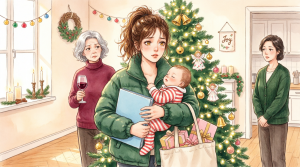
I hadn’t even taken my coat off when my mother looked at my baby and asked why I had come to Christmas.
Not why I was late.
Not whether the drive had been safe in the snow.
Not how I was feeling after the infection that had put me in urgent care the week before.
Just that.
“Why did you come to Christmas?”
She stood beside the tree with a wine spritzer in her hand, wearing the pearl earrings I had bought her for Mother’s Day.
Behind her, warm white lights blinked over gold ribbon and glass ornaments.
The house smelled like cinnamon candles, roasted turkey, and the expensive pine garland she insisted on ordering every year because artificial greenery looked “cheap.”
My daughter, Emma, was nine months old and half-asleep against my chest.
She had spent most of the two-hour drive dozing while snow tapped against the windshield.
Her cheeks were pink from the cold.
Her tiny fingers gripped the edge of my scarf with that soft, unconscious trust babies have when they believe the whole world is still safe.
She wasn’t crying.
She wasn’t fussing.
She was just looking around.
My mother’s eyes moved over her like she was seeing a stain.
“Your baby makes people uncomfortable,” she said.
The room did not go silent because of shock.
That was the first thing I noticed.
No one gasped.
No one corrected her.
No one said my name in that warning tone people use when someone has crossed a line.
Across the living room, my father sat in his recliner with the football game reflected in his glasses.
He did not turn fully toward me.
He only glanced over, saw my face, and smirked.
“She’s right,” he said.
“Sit this one out.”
For a few seconds, all I could hear was the sound of the game announcer, the soft click of ice in my mother’s glass, and Emma’s little breath against my collarbone.
I stood there with my daughter on one hip and a giant reusable shopping bag hanging from my other arm.
It was packed with wrapped presents, cards, gift receipts, and the small velvet box Jenny had asked me to pick up because she “never had time for herself anymore.”
The bag cut into my fingers.
My back throbbed from the drive.
My coat was damp at the shoulders where snow had melted into the wool.
Underneath it all, my body still felt battered from mastitis, from fever, from nights of rocking a baby while trying not to cry from pain.
Nobody offered to take the bag.
Nobody asked if I needed to sit.
Nobody said hello to Emma.
My sister Jenny appeared in the kitchen doorway holding a mimosa.
She was already flushed, the way she got when she had decided a gathering belonged to her.
She looked at me, then at Emma, then at the wet mark my boots had left on the floor.
“Great,” she muttered.
“Here we go.”
One of her sons sat cross-legged near the tree, tapping on a brand-new iPad still wearing a red bow on the corner.
I knew the model.
I knew the price.
I knew because Jenny had texted me a screenshot two weeks earlier and written, He’ll be crushed if he doesn’t get this one.
I had
sent the money within an hour.
I always did.
That was the arrangement nobody called an arrangement.
I was the oldest daughter.
I was the responsible one.
I had the stable job, the good credit, the savings account, the one-bedroom apartment I kept tidy because it was the only place where I could breathe.
When my father lost his position three years earlier and decided he was “between opportunities,” I covered the car payment once.
Then twice.
Then every month.
When my mother said the mortgage had “gotten complicated,” I paid the overdue balance.
When Jenny cried that daycare would ruin her and her husband had been “unlucky again,” I handled tuition, groceries, summer camp deposits, emergency dental bills, and birthday parties that somehow had balloon arches and catered cupcakes.
They never thanked me in public.
In private, they called it family.
Standing there on Christmas afternoon, holding the only person in that room who had never taken anything from me, something inside me went quiet.
It did not snap.
It did not explode.
It settled.
“If I’m not welcome,” I said, “that’s fine.”
My mother blinked, surprised by the calmness in my voice.
Jenny gave a small laugh.
“Oh my God, don’t make it a production.”
My father lifted his beer without looking at me.
“Nobody said you weren’t welcome.
We said the baby changes the mood.”
“The mood?” I repeated.
My mother sighed as if I was forcing her to explain something obvious.
“People came here to relax.
You know how babies are.
And after everything…”
She stopped.
That unfinished sentence hung between us.
After everything.
She meant after I had Emma without a husband.
After I stopped pretending I was ashamed.
After I refused to explain her father to relatives who wanted a version they could digest.
After I stopped letting my mother use words like unfortunate and situation and choices when she talked about the child in my arms.
Emma shifted against me and made a soft sound.
My mother’s mouth tightened.
I looked at her, then at my father, then at Jenny.
“This is the last time I do this,” I said.
Jenny rolled her eyes.
“Do what?”
“Show up with gifts after being treated like a problem.”
My father finally muted the television.
That was how I knew I had his attention.
I took a breath.
“And if you don’t want me or my daughter here, then I will stop financing your lifestyle.”
For one heartbeat, the whole room froze.
Then they laughed.
Not because it was funny.
Because they thought the idea was impossible.
My father actually clapped once, slow and sharp.
“Listen to her.”
Jenny leaned against the doorway, smiling with all her teeth.
“That infection really messed with your head, huh?”
My mother set her glass down too hard on the side table.
“You always need attention.
Always.”
I did not defend myself.
I did not list every bill.
I did not remind Jenny that I had paid for her son’s iPad, her daughter’s dance fees, and the matching Christmas pajamas she posted online with the caption blessed beyond measure.
I simply shifted the shopping bag onto the entry table and unzipped the front pocket.
My mother’s eyes flicked toward my hand.
That was when the laughter thinned.
I pulled out
a blue folder.
It was not thick.
It did not need to be.
Inside were copies of documents I had printed that morning at the office because some part of me had known, before I ever got in the car, that this Christmas would end differently.
I placed the first page on the entry table.
My father’s face changed before he stood up.
It was the mortgage statement for the house we were standing in.
My name was printed clearly under authorized payer.
My mother took one step forward.
“What are you doing?”
“Making sure nobody’s confused,” I said.
Jenny’s smile vanished.
“Why would you bring paperwork to Christmas?”
“Because you brought cruelty to Christmas,” I said.
The words surprised even me.
They came out steady, but they landed hard enough that my aunt Linda stopped laughing from the dining room.
My cousin Mark appeared behind her with a dinner roll in his hand, confused, chewing slowly like he had walked into the wrong scene.
I opened the folder again.
“Mortgage arrears from March,” I said, laying down one page.
“Paid by me.
April, May, June, July, August, September, October, November, December.
Paid by me.”
My mother’s face flushed.
“This is private.”
“You mean secret,” I said.
My father got up from the recliner.
He moved heavily, more angry than embarrassed.
“Put that away.”
I looked at him.
“The truck payment.
Paid by me.
Your insurance.
Paid by me.
The repair on the furnace you told everyone you handled? Paid by me.”
Aunt Linda’s eyes moved from my father to my mother.
Jenny let out a sharp laugh that had no humor left in it.
“So what, you helped your parents? Congratulations.
You want applause?”
I turned the next page around.
Her name was on it.
“Your rent in May,” I said.
“The emergency credit card balance in June.
Camp deposits in July.
School clothes in August.
Groceries in September.
The phone bill in October.
The dance competition deposit you told Mom was covered by your husband’s bonus.”
Jenny went pale under her foundation.
“That is none of their business,” she hissed.
“It became their business when you called my baby uncomfortable in a room full of people while wearing earrings I paid for.”
My mother touched her earrings like they had suddenly burned her.
Emma began to fuss, not loudly, just a small restless whimper.
I bounced her gently and pressed my cheek to her hair.
“It’s okay,” I whispered.
“Mommy’s got you.”
Nobody in the room moved.
My father took two steps toward me and lowered his voice.
“You are embarrassing your mother.”
That sentence had worked on me for thirty-four years.
It worked when I was eleven and won a school award my mother said I bragged about too much.
It worked when I was seventeen and my father told me not to mention scholarship money in front of Jenny because she was sensitive.
It worked when I was twenty-six and I postponed my own plans to help them refinance.
It worked when I was pregnant and alone and my mother told me my choices were humiliating enough without me “acting proud.”
But with Emma’s warm weight in my arms, it did not work anymore.
“No,” I said.
“She embarrassed herself.”
My father’s jaw tightened.
Jenny looked
toward the dining room, realizing the relatives had gathered now.
Aunt Linda.
Uncle Paul.
Two cousins.
Jenny’s husband, Travis, standing behind the kitchen island with his hand frozen around a beer bottle.
For the first time, the people who had been told for years that I was distant, dramatic, selfish, and too good for the family were watching the numbers with their own eyes.
My mother reached for the folder.
“Give me that.”
I stepped back.
“Don’t touch it.”
The room went colder than the entryway behind me.
My mother’s voice dropped.
“You think money gives you the right to disrespect us?”
“No,” I said.
“I think motherhood gives me the right to protect my child.”
Jenny scoffed.
“Protect her from what? Nobody did anything to her.”
I stared at my sister until she looked away.
“You looked at her like she was something shameful.”
“She’s a baby,” Jenny snapped.
“Exactly.”
That was the word that finally cracked something open.
Because for all their complaints, all their whispered comments, all their carefully chosen insults, the truth was painfully simple.
Emma was a baby.
She had no debts.
No scandals.
No opinions.
No power.
She had entered this house trusting the arms that carried her.
And they had rejected her before she could even understand the word family.
My mother pressed her lips together.
“You’re twisting this.”
“Then untwist it,” Aunt Linda said.
Every head turned toward her.
She was a quiet woman, the kind who noticed everything and said little until the exact moment silence became a sin.
She set her napkin on the dining table and walked closer.
“Tell us why a nine-month-old makes you uncomfortable,” she said.
My mother’s eyes flashed.
“Linda, stay out of this.”
“No,” Aunt Linda said.
“I don’t think I will.”
My father looked trapped between rage and calculation.
He had always been good at reading rooms, and this room had stopped belonging to him.
Jenny’s husband Travis cleared his throat.
“Wait.
You paid the rent in May?”
Jenny spun toward him.
“Not now.”
His face hardened.
“You told me your mom helped.”
“She did help,” Jenny said.
“With her money?”
Jenny said nothing.
That was another silence with teeth.
My mother tried to recover.
“This has gotten ugly because your sister chose to humiliate everyone.”
“I chose to tell the truth,” I said.
“And what do you want?” my father demanded.
“A throne? A crown? You helped your family.
That’s what family does.”
I looked around the room at the garland, the gifts, the fire glowing behind the screen, the dinner waiting under foil in the kitchen.
I saw all the comfort I had been funding while eating leftovers in my apartment and telling myself things would get better when they felt secure.
They had never wanted security.
They wanted access.
“I want nothing,” I said.
My father laughed once.
“There it is.
Martyr act.”
“I mean it,” I said.
“Nothing.
From today forward, that is what I will give you.”
My mother stared at me.
I opened the banking app on my phone with one hand.
Emma was calmer now, watching the room with wide eyes.
Her little sock had slipped halfway off, and I fixed it while my father watched my thumb move across the screen.
“What are you doing?” he
asked.
“Canceling the automatic payments.”
My mother’s hand flew to her mouth.
Jenny stepped forward.
“You cannot be serious.”
I tapped the first scheduled payment and canceled it.
Then the next.
Then the next.
My father’s voice changed.
It lost the smirk and found something uglier.
“You’re punishing us over one comment.”
“No,” I said.
“I’m ending a pattern over years of them.”
My mother’s eyes filled with tears, but they were not soft tears.
They were angry tears, the kind she used when she wanted the room to move toward her instead of the truth.
“So you’re going to make us lose the house?” she asked.
“No,” I said.
“You’re going to decide whether to pay for the house you live in.”
Aunt Linda made a small sound, almost approval, then looked away.
Jenny’s son glanced up from the iPad, sensing adult tension at last.
He looked at me, then at his mother.
I hated that he had to see any of it.
I hated that the children were in the room.
But I hated more that my daughter would someday be old enough to understand if I kept teaching her that love meant standing still while people made you smaller.
Jenny came close enough that I could smell orange juice and champagne on her breath.
“You think you’re better than us because you have a job,” she whispered.
“No,” I said.
“I think I forgot I had a choice.”
Her face twisted.
Then she said the thing she had apparently been holding all day.
“Maybe Mom was right.
Maybe none of this would be happening if you had made better choices before having her.”
The air dropped out of the room.
My aunt said, “Jenny.”
My father closed his eyes.
My mother did not correct her.
That was the final answer I needed.
I looked down at Emma.
She was staring at the Christmas lights, one hand still wrapped in my scarf, innocent of every ugly word that had just been thrown over her head.
I kissed her temple.
“Thank you,” I said.
Jenny blinked.
“For what?”
“For making it easy.”
I gathered the folder, slid it back into the bag, and pulled out the small stack of gift envelopes.
Every adult in that house had one.
I had written names in gold ink the night before while Emma slept beside me.
Inside were checks, gift cards, and a few notes I had written because part of me still wanted to be loved by people who had learned to invoice me instead.
I tore the first envelope in half.
My mother gasped.
I tore the second.
Jenny lunged forward.
“Stop it.”
I held the rest behind me.
“They were mine to give.”
My father’s face had gone dark red.
“You are making a mistake you’ll regret.”
I looked at him for a long moment.
The man who had taught me to ride a bike, who had once carried me from the car when I pretended to be asleep, who had slowly become someone who saw my love as a utility bill.
Maybe I would grieve him later.
But I did not regret anything in that room.
I picked up the shopping bag with the remaining presents.
The iPad would stay.
The children would not be punished for their
parents.
But the adult gifts, the payments, the invisible safety net, the emergency rescues, the quiet deposits sent at midnight after dramatic texts, all of it ended there.
At the door, my mother’s voice broke in a way that might once have stopped me.
“Are you really choosing a baby over your family?”
I turned back.
Everyone was watching me.
I shifted Emma higher on my hip, and for the first time that day, my daughter smiled.
Not at them.
At me.
A small gummy smile, warm and trusting, like she knew the answer before I said it.
“No,” I said.
“I’m choosing my family.”
Then I walked out.
The cold hit my face so sharply it almost felt clean.
Snow had covered the front steps again.
I buckled Emma into her car seat, wrapped the blanket around her legs, and sat behind the wheel with my hands resting on the steering wheel until they stopped shaking.
My phone began buzzing before I reached the end of the driveway.
My mother called first.
Then Jenny.
Then my father.
Then Jenny again.
Messages piled up, each one a different costume for the same demand.
You humiliated us.
You misunderstood.
Don’t be cruel.
Dad’s blood pressure is up.
The mortgage comes out next week.
Think of the kids.
I did think of the kids.
I thought of Jenny’s children, who deserved parents who did not build Christmas around someone else’s sacrifice.
I thought of Emma, who deserved a mother who did not keep walking into rooms where she was treated like a stain.
I thought of the girl I had been, trained to believe that love was proven by how much discomfort she could swallow.
Then I turned my phone on Do Not Disturb and drove home.
The next morning, I sent one email.
It went to my parents, Jenny, and Travis.
I kept it factual.
No insults.
No speeches.
I listed every recurring payment I had canceled, every account I would no longer cover, and the date my help had officially ended.
I attached copies of the statements so nobody could pretend not to understand.
At the bottom, I wrote one sentence.
Until every adult in this family can acknowledge what happened and apologize directly for how Emma and I were treated, there will be no contact.
My mother replied within four minutes.
You are holding money over our heads.
I wrote back once.
No.
I am removing my neck from under your foot.
Then I blocked her for thirty days.
It was not peaceful at first.
Peace did not arrive like a choir.
It came in strange, guilty pieces.
I woke up on the first of the month panicked, reaching for my phone to make sure the mortgage payment had processed before remembering it was no longer mine to process.
I cried in the grocery store because Jenny’s daughter’s favorite cereal was on sale and I almost bought three boxes out of habit.
But then my apartment got quieter.
My bank account stopped bleeding.
My body healed.
Emma learned to clap, then to pull herself up on the coffee table, then to laugh whenever I made snowflakes out of paper and taped them to the window.
For New Year’s Eve, I held her on my lap in pajamas and watched
the neighborhood fireworks bloom in the distance.
There were no insults.
No smirks.
No one asking why we had come.
In late January, Aunt Linda called.
She said my parents had told everyone I abandoned them.
Then she said Travis had asked her for the folder because Jenny had confessed they were months behind on more than rent.
The story my family had built around me was cracking in places they could not patch with gossip.
“Your mother wants to talk,” Aunt Linda said gently.
I looked at Emma sleeping in her crib, one fist curled beside her cheek.
“Does she want to apologize?” I asked.
Aunt Linda was quiet.
That was answer enough.
The mortgage did not get paid on time that month.
My parents did not lose the house immediately, despite their dramatic messages through relatives.
They had savings.
Not much, but enough.
My father picked up contract work.
My mother sold the expensive holiday decorations she had once said made the house feel worthy.
Jenny and Travis moved into a smaller rental after Travis finally saw how much of their life had been propped up by my quiet deposits.
None of that felt like victory.
It felt like watching people learn gravity after years of pretending I was the floor.
Three months later, a letter arrived in my mother’s handwriting.
I almost threw it away.
Instead, I opened it while Emma sat in her high chair smearing banana across the tray.
The letter was not perfect.
It began with excuses.
It wandered through embarrassment and stress and old family wounds that were somehow supposed to explain why a grandmother could look at a baby and speak with disgust.
But near the end, my mother wrote one sentence that made me sit down.
I was cruel to Emma because I was angry at you for becoming happy without needing my approval.
I read it three times.
Then I folded the letter and put it away.
I did not call her that day.
I did not rush to forgive because she had finally named the wound.
An admission was not a repair.
A sentence was not safety.
My daughter was not a bridge they could walk across whenever guilt became inconvenient.
Eventually, months later, I agreed to meet my mother in a park for one hour.
No holiday.
No audience.
No gifts.
No money.
She brought a small stuffed rabbit for Emma and asked before handing it to her.
She cried when Emma laughed at a dog running past us, but she did not ask to hold her.
She did not ask for money.
She did not ask when things would go back to normal.
They never did.
That was the point.
Normal had been me paying bills while swallowing insults.
Normal had been my parents enjoying comfort while calling my boundaries disrespect.
Normal had been Jenny dressing her jealousy as concern and my father turning cruelty into a punchline.
The new version was smaller.
Cleaner.
Stricter.
My parents saw Emma only when I chose, and never in my home until trust had been rebuilt in small, boring, consistent ways.
Jenny did not see me for nearly a year.
When she finally texted an apology, it was short and awkward and missing half of what it needed.
I accepted
that she had written it.
I did not accept her back into my life.
That Christmas, I did not drive through snow with a bag full of gifts for people who measured my worth by my usefulness.
I stayed home.
Aunt Linda came over in the afternoon with a casserole and a ridiculous singing reindeer for Emma.
We ate in my little kitchen with paper snowflakes in the windows and toys scattered across the rug.
Emma pulled herself along the couch, wearing red socks with tiny white bows, and every time she looked back at me, she smiled like she knew she belonged.
My phone stayed quiet most of the day.
In the evening, one message came from my father.
Merry Christmas.
That was all.
No demand.
No guilt.
No insult hidden under holiday language.
I stared at it for a long time before typing back.
Merry Christmas.
Then I put the phone down and returned to the living room, where my daughter was trying to eat the corner of a wrapping paper tube while Aunt Linda laughed so hard she had tears in her eyes.
Some people would say I was harsh.
Some would say family should be forgiven faster, especially at Christmas.
Some would say money should never be used to make a point.
But I still think about that moment in the doorway, my baby quiet in my arms, my mother’s voice cold enough to turn a home into a warning.
And I know this much.
The most expensive thing I ever paid for was not their mortgage, their gifts, or their emergencies.
It was the years I spent buying a place in a family that should have made room for my daughter for free.
THE END