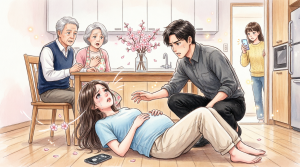
her turned.
“Ma’am, what is on that phone?”
“Nothing,” Helena snapped.
Nora swallowed.
Her hand trembled.
That was when Victor made his mistake.
“Give me the phone,” he barked at her.
He forgot who had the badge in the room.
The deputy stepped between them.
“Nobody touches that device.”
Nora looked at me.
I still remember that moment better than the pain.
She looked at my face, at the hair torn loose around it, at my hands still clutched protectively over my stomach.
She looked at her brother, then at her mother, then back at me.
And something inside her finally cracked.
“I recorded it,” she said.
Helena’s mouth fell open.
Nora’s eyes filled immediately, as if she hated herself for speaking but hated what she’d done even more.
“I recorded all of it.
He hit her.
Mom laughed.
Dad told him to catch her.
It’s all there.”
Victor swore and lunged once, not at me this time but toward Nora.
The deputy stopped him instantly and forced him against the wall.
Metal cuffs clicked shut with a sound I can still hear clearly.
I didn’t enjoy that sound the way I used to imagine I would if he were ever caught.
I was too exhausted.
Too shaken.
Too aware of how close everything had come to ending differently.
The ambulance ride blurred in and out.
Alex rode beside me, answering questions when I couldn’t.
At the hospital, they checked the baby before they checked anything else.
Those minutes were worse than the violence.
Bruises heal.
Waiting to hear whether your child is still alive is its own kind of torture.
Then I heard the heartbeat.
Fast.
Steady.
Furious little drumbeats filling the dim exam room.
I cried so hard the nurse cried with me.
The baby was stressed but alive.
I had a severe bruise on my thigh, a concussion, dehydration, and a sprain in my wrist from the fall.
The doctor looked me straight in the eye and said, gently but clearly, “You were lucky.”
I hated that word.
Lucky meant it could have gone the other way.
A detective met me that afternoon after the fetal monitor was finally removed.
Alex stayed in the room but silent, one hand around a paper cup he never drank from.
When the detective asked whether this was the first time Victor had hurt me, the answer sat in my throat like broken glass.
No, I said eventually.
Not the first time.
Once that door opened, everything else came out.
The shove into the bathroom door when I was eight weeks pregnant.
The nights Victor took my phone and told me I didn’t need anyone but his family.
Helena calling me weak for vomiting.
Raúl refusing to let me attend prenatal appointments unless Victor was free to drive me.
The way Nora laughed at first and then copied whatever mood the room demanded.
The money he controlled.
The locks he changed.
The apologies that always came with conditions.
The detective didn’t interrupt.
He just kept writing.
By evening, they had the video from Nora’s phone.
She had tried to film it as entertainment, something cruel and secretive to mock later.
But she had set her cloud backup to automatic.
Deleting it in the kitchen would not have mattered.
The footage had
already uploaded the second she recorded it.
That was the part that destroyed them.
Not the excuses.
Not the broken stick.
Not even the bruises blooming across my skin.
The truth, caught in their own voices.
Victor shouting.
Helena laughing.
Raúl ordering.
My scream.
My plea for the baby.
And Nora, silent behind the camera until the very end.
The prosecutor moved quickly.
Victor was charged first.
Helena and Raúl were charged too after the video showed them encouraging the assault and trying to cover it up.
The county filed for an emergency protective order before I was even discharged.
Victor sent messages from jail through a cousin at first.
He said he was sorry.
Then that I had ruined his life.
Then that Alex had poisoned me against my own husband.
The messages stopped when my lawyer got involved.
I filed for divorce from Alex’s guest room, wrapped in one of his old Marine hoodies because my own clothes still smelled like that house.
I should tell you that leaving felt triumphant.
It didn’t.
It felt humiliating, exhausting, and strangely quiet.
I slept with the lamp on.
I cried when cabinet doors closed too hard.
I flinched when Alex raised his voice at football on television even though it had nothing to do with me.
There are some cages you leave physically before your body believes you are gone.
The trial started three months later, when my belly had grown round enough that strangers opened doors for me and smiled.
I hated almost all of them for being gentle too late.
Victor looked smaller in court than he ever had in our house.
Abuse shrinks in daylight.
That doesn’t make it less dangerous.
It just makes it look more pathetic.
His attorney tried everything.
Stress.
Financial pressure.
Marital conflict.
My “fragile emotional state.” The usual dirty trick of turning pain into unreliability.
Then the prosecutor played Nora’s video.
No one in the courtroom moved.
There is something almost unbearable about hearing your own fear played back through speakers while the people who caused it sit ten feet away pretending there is context that could rescue them.
Victor’s voice came first, sharp and ugly.
Then Helena laughing.
Then my body on the floor.
Then Raúl yelling, “Catch her.” Then the crack of the stick.
Then me begging for the baby.
By the time the video ended, Victor wouldn’t look at the screen.
Helena still tried to hold onto her pride.
“Families say things in the heat of the moment,” she told the court during her testimony.
The prosecutor asked, “Did you also laugh in the heat of the moment?”
For the first time, Helena had no answer.
Raúl folded faster.
He admitted they had all treated me badly, though he called it discipline instead of abuse.
As if changing the label could clean it.
As if terror becomes respectable when an older man says it calmly.
Nora was the wildcard.
The prosecutor called her last.
She walked to the stand with swollen eyes and shaking hands.
She didn’t look dramatic.
She looked wrecked.
That made her more believable, not less.
“I thought it was normal,” she said at first.
“Not normal exactly.
Just…
how things were in our house.
Mom laughed, so I laughed.
Victor yelled, so we all acted
like he had the right.”
The courtroom stayed silent.
Then she looked at me.
“I knew she was scared,” Nora said, voice breaking.
“I knew.
I filmed it anyway.”
There are confessions that sound polished and self-protective.
Hers did not.
It sounded raw, ugly, and late.
She admitted Helena told her to record me on bad days so they could mock me in the family group chat.
She admitted Victor had hit walls before, and once a chair, and once the dashboard of his truck so hard his hand swelled.
She admitted that when I fainted, everyone thought first about excuses, not help.
She also admitted that when Helena told her to delete the video, she couldn’t do it.
“Why not?” the prosecutor asked.
Nora started crying in a way that seemed to tear out of her, not perform for anyone.
“Because she said, ‘Please, the baby,’ and I couldn’t stop hearing it.”
That testimony buried the rest of the defense.
Victor was convicted.
Helena and Raúl were convicted too.
The judge didn’t speak dramatically when he sentenced them, which somehow made his words hit harder.
He called the home a place of coordinated cruelty.
He called the attack deliberate.
He called my pregnancy an aggravating factor, not a shield that anyone in that house respected.
When it was over, Victor finally looked at me.
Not with remorse.
With disbelief.
As if he still couldn’t understand how the woman he dragged across his kitchen floor had somehow become the one standing while deputies led him away.
I did not look back.
My daughter was born seven weeks later on a rainy Thursday afternoon.
Alex held my shoulder through labor and cried harder than I did when the nurse placed her on my chest.
She had a furious little frown, a full head of dark hair, and a heartbeat that sounded like survival.
I named her Grace, which surprised people who expected something sharper after everything that happened.
But grace isn’t softness to me.
Grace is what remains when brutality doesn’t finish the job.
The divorce was finalized before Grace was three months old.
The judge granted full custody, no visitation without extraordinary court approval, and permanent protection orders.
I moved into a small apartment with squeaky floors, terrible water pressure, and windows that faced east so the morning light poured in warm and clean.
I loved that apartment more than houses twice its size.
For a while, healing looked unimpressive.
Folding tiny clothes.
Going to therapy.
Learning that not every knock on the door meant danger.
Eating breakfast without listening for footsteps.
Letting my daughter fall asleep on my chest without wondering whether I had been selfish to bring her into the world.
Then, one afternoon, a letter arrived.
No return address, but I recognized Nora’s handwriting immediately.
I almost threw it away unopened.
Instead I sat at my kitchen table with Grace asleep in her carrier and read every word.
Nora wrote that prison had taken Victor’s swagger and Helena’s certainty, but that wasn’t why she wrote.
She wrote that she had started therapy.
That for the first time in her life, a counselor had called what happened in that house by its real name.
Abuse.
Not discipline.
Not family stress.
Not marriage problems.
Abuse.
She wrote that she
knew saying sorry changed nothing.
She wrote that she still woke up hearing my voice beg for the baby.
She wrote that handing over the phone did not make her brave.
It made her less monstrous than she had been five minutes earlier.
She said she would understand if I hated her forever.
I read the letter twice.
Then I put it back in the envelope and slid it into a drawer.
Alex asked later if I was going to answer.
I told him I didn’t know.
That was the only honest response I had.
People love clean endings.
Monster punished.
Victim healed.
Everyone placed into the right box and labeled forever.
Real life is messier.
Victor, Helena, and Raúl were easy to name.
Nora wasn’t.
She laughed.
She recorded.
She helped create the humiliation.
Then she told the truth when it mattered most.
Some days I think that doesn’t deserve mercy.
Other days I look at Grace sleeping beside the window, at the light touching her face, and I think the most frightening thing about a house like that is how it trains people to call cruelty ordinary until one person decides not to.
I never answered Nora’s letter.
Maybe that was my answer.
Maybe silence was the only thing I still owned completely.
But I kept the envelope.
Not because she earned forgiveness.
Because the hardest part of surviving that morning was not learning who the worst people were.
It was accepting that sometimes the person who helps save you is also one of the people who stood there and watched.

