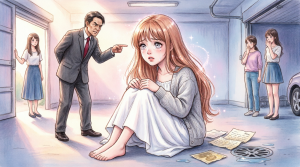
false supporting documents and pressure emails. My mother was not charged with assault, but she gave a formal statement and ended up subpoenaed in the fraud case anyway.
The house they were so desperate to save?
They lost it.
Not because of me, despite what certain extended relatives still enjoy saying at holiday gatherings I no longer attend.
They lost it because it had been sinking for years under bad decisions, secret bailouts, and the delusion that my credit could be turned into a life raft without my consent.
Months later, I sat in court with my arm mostly healed, a faint scar at the edge of my lip, and listened to my father’s attorney describe the assault as a “highly emotional family misunderstanding.” I watched Melissa dab at her eyes with a tissue like she was the wounded one.
Then the prosecutor played the garage recording.
No one in that courtroom could call it a misunderstanding after that.
Not the part where my father said, “Sign it now and fix this.”
Not the part where I said, “You used my information.”
Not the part where Melissa hissed, “You should have signed the mortgage.”
And certainly not the part where the impact could be heard, followed by me crying out and my mother saying, too late, too small, “Richard, enough.”
My father was convicted on assault-related charges and pled on the fraud counts after the mortgage evidence stacked too high to explain away. Melissa took a plea deal. Darren cooperated to avoid worse. My mother disappeared into one of those sad little apartments that smell like dust and denial.
I changed my number. Froze my credit permanently. Moved. Started trauma therapy. Learned how to stop apologizing when someone else crosses a line.
People always want a neat ending after a story like mine. They want justice tied in a bow. They want me to say court fixed everything, or prison healed childhood, or consequences restored my faith in blood.
That is not how it works.
Justice mattered. It mattered deeply.
But the real shock of what happened was not that the police believed me, or that the recording existed, or that the fraud unraveled.
It was that, for the first time in my life, I stopped confusing survival with loyalty.
I stopped thinking love required access.
I stopped mistaking being useful for being valued.
There are still nights when I wake up with my shoulder aching in bad weather and the smell of cold concrete somehow back in my nose. There are still moments when I hear a certain kind of male shout in a parking lot or a grocery store and my body reacts before my mind does.
But there is also this:
I own my home now.
My documents live in a fireproof safe.
No one has my passwords. No one has my keys. No one gets to use the word family as a crowbar against my life.
Sometimes people ask me what I felt when the judge handed down the sentence.
Relief, yes.
Grief, absolutely.
But most of all, clarity.
Because by then I understood something I wish I had learned much younger:
The worst thing my father broke in that garage was not my shoulder.
It was the last illusion that I owed my future to
people who would have signed my name away the second I looked down.