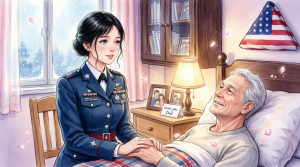
The machines kept beeping. The hallway kept moving. Somewhere nearby, a nurse laughed quietly at something another nurse said. The world continued in all its ordinary ways while my father’s sentence detonated inside me.
Then it becomes God’s decision.
Not a mistake. Not stress. Not caregiver burnout. A calculation.
I stood so abruptly the chair scraped back.
“Emma,” Grandpa said.
“I need a minute.”
“No.”
I stopped at the door.
His voice, though weak, carried the old command I remembered from childhood—the one he used when a storm was coming and he needed everyone inside.
“Come here.”
I came back.
“Sit down.”
I sat.
He looked at me until my breathing steadied.
“Your grandmother said truth,” he whispered. “Not rage.”
“I know.”
“No, you don’t. Not yet. You’re young. You think rage makes you strong because it gets you moving. But rage is a terrible driver. It will take the wheel and put you in a ditch.”
“They left you to die.”
His eyes flashed. “And I am still here.”
That stopped me.
He squeezed my fingers with surprising strength.
“I want them held accountable,” he said. “Every dollar. Every lie. Every hour they left me in that cold room. I want all of it in daylight. But I don’t want you becoming what they are. Promise me.”
I looked at his hand in mine. The skin was thin, the veins raised, the knuckles swollen from arthritis. This hand had baited hooks for me, held my bike seat while I learned balance, slipped twenty-dollar bills into my birthday cards, waved from the bleachers at my high school graduation, saluted me with trembling pride when I came home from boot camp.
“I promise,” I said.
I meant it.
Mostly.
Margaret Whitfield arrived Christmas morning wearing a gray wool coat, snow boots, and an expression that made me understand why Grandma had trusted her. She was in her sixties, tall, elegant, with short white hair and a leather briefcase that looked older than me. She did not waste time on sentimental greetings. She walked into Grandpa’s room, took his hand, and said, “Richard, Elizabeth told me you would wait too long.”
Grandpa gave a weak laugh that turned into a cough.
Margaret smiled sadly. “Still stubborn, I see.”
“Still expensive?” he rasped.
“Extremely.”
That made him smile for real.
She asked everyone but me to leave while she spoke with him privately. Even Denise stepped out. I stood in the hallway beside a vending machine and watched families pass with gift bags and poinsettias. Christmas morning in a hospital has a strange sadness to it. People try harder than usual to be cheerful, which only makes the fear underneath more visible.
After twenty minutes, Margaret opened the door and waved me in.
Grandpa looked tired but alert. Margaret had a yellow legal pad on her lap.
“Your grandfather has capacity,” she said. “I have spoken with his attending physician, and a formal assessment will be placed in his chart. He understands his assets, his family relationships, the nature of the documents we discussed, and the consequences of his decisions.”
I nodded, though my heart was pounding.
“First,” Margaret continued, “he is revoking the financial power of attorney previously granted to your father. Immediately. I’ll prepare the notice and send it to the bank, the county recorder, and any relevant institutions.”
Grandpa stared at the ceiling like hearing that out loud cost him something.
“Second,” she said, “he is appointing you as his healthcare proxy and limited financial agent, subject to accounting requirements. That means every transaction will be documented. No informal arrangements. No gray areas.”
“Good,” I said.
“Third, we are petitioning the court for a protective order preventing your parents from removing property, accessing accounts, or contacting Richard except through counsel until the court reviews the matter.”
I looked at Grandpa. “You’re okay with that?”
His jaw flexed.
“No,” he said. “But do it.”
Margaret’s eyes softened for half a second. Then she went on.
“Fourth, I need you to understand something about the house. Your parents may believe they have a claim to it. They do not.”
I remembered the deed in the tin. “It’s still in Grandpa’s name.”
“In a manner of speaking,” Margaret said. “Elizabeth and Richard placed the home into a revocable trust years ago. Richard is the current trustee. You are the successor trustee. Your father knows a trust exists, but he does not know the terms. Elizabeth insisted on certain safeguards.”
Grandpa closed his eyes.
Margaret looked at me.
“If Mark Bennett is found by a court to have financially exploited, neglected, or abused Richard, he is treated under the trust as having predeceased him.”
I blinked. “Meaning…”
“Meaning he inherits nothing.”
The room went very quiet.
Not empty quiet. Loaded quiet.
Grandpa whispered, “Elizabeth called it the Judas clause.”
Margaret gave him a look. “I advised against that name.”
“She liked it.”
“I know she did.”
For the first time since I had found Grandpa in that freezing room, something like dark humor flickered in the air. Grandma had been gentle, yes. She had smelled like vanilla and lavender soap. She had cried at old hymns and fed stray cats. But she had also raised three children, survived breast cancer once before it came back, and once chased a raccoon off the porch with a broom while Grandpa laughed too hard to help her.
Of course she had built a trap and named it the Judas clause.
Margaret opened her briefcase and removed a slim tablet.
“There is more,” she said.
Grandpa turned his face away.
“Richard?”
“Show her.”
Margaret tapped the screen. A video opened.
Grandma appeared sitting in the den, in her chair, wearing a blue cardigan I recognized immediately. She looked thinner than I remembered, her cheekbones sharp, her hair tucked beneath a patterned scarf. But her eyes were clear.
“Emma,” she said on the screen, and I felt the room tilt. “If you are watching this, I am sorry. It means your grandfather needed protection and your parents failed him badly enough that Margaret decided the recording was necessary.”
I covered my mouth.
The video Grandma looked down at papers in her lap, then back up.
“I want you to know that your grandfather and I made these decisions together while I was of sound mind. We did not disinherit your father because he was imperfect. All children are imperfect. All parents are, too. We made these provisions because Mark began pressuring Richard for money while I was ill, because Sharon encouraged it, and because both of them seemed to believe our age made us easier to manage.”
She paused to breathe.
“Maybe they will change. I hope they do. But hope is not a legal strategy, Margaret says.”
Off-screen, Margaret’s voice said, “I did say that.”
Grandma smiled faintly.
“So here is mine. If they care for Richard with decency, they will not be punished for past selfishness. But if they exploit him, isolate him, neglect him, abandon him, or attempt to take his home, the record will speak for itself. Emma, do not let anyone tell you that protecting your grandfather is betrayal. The betrayal happened before you arrived.”
The video ended.
I couldn’t move.
Grandpa was crying silently now, tears sliding into his white hair.
Margaret closed the tablet.
“I wish you had never needed to see that,” she said.
“So do I,” I whispered.
By noon on Christmas Day, while other families opened presents and burned cinnamon rolls and argued about football, Margaret Whitfield filed emergency motions from her laptop in the hospital cafeteria. Detective Pike called to say a financial crimes investigator would be assigned. Denise confirmed Adult Protective Services had opened a case. Officer Ortiz returned to the house to make sure no one entered before the protective order was in place.
By two o’clock, my parents’ cruise ship reached a port in Cozumel.
By three, their cards stopped working.
I know this because my mother called me at 3:17 p.m.
Her name flashed on my phone while I was spooning ice chips into Grandpa’s mouth.
MOM.
For a second, I stared at it like it was a snake.
Grandpa saw my face. “Answer.”
“I don’t think—”
“Speaker.”
I swiped and put the call on speaker.
“Emma?” My mother’s voice came through bright and irritated, with wind in the background. “Finally. Why haven’t you answered my texts?”
“You didn’t text me.”
“Well, I tried, but the service out here is terrible. Listen, something is wrong with the credit card. Your father is at guest services losing his mind. Did you do something?”
Grandpa closed his eyes.
I looked at Margaret, who had returned with coffee. She lifted one finger to her lips, then took out her own phone and began recording.
“Emma?” Mom snapped. “Are you there?”
“I’m here.”
“Where are you? At the house?”
“No.”
A pause.
“Where’s your grandfather?”
“At the hospital.”
The wind noise seemed to vanish.
“What do you mean, at the hospital?”
“I found him hypothermic and barely responsive in the guest room.”
My mother inhaled sharply. Not grief. Not fear. Calculation.
“Oh my God. Is he being dramatic again? Your father told him to keep blankets on, but he never listens. You know how stubborn he is.”
Grandpa opened his eyes.
Something inside me went very still.
“He was alone in a forty-eight-degree house with no working phone.”
“We were only gone for a few days.”
“You left a note telling me to take care of him.”
“Well, because you were coming home.”
“My flight could’ve been delayed.”
“But it wasn’t.”
Margaret’s face hardened.
Grandpa stared at the phone like my mother’s voice was a stranger’s.
“You shut off his phone line,” I said.
“Landlines are expensive, Emma. Everyone has cell phones now.”
“He doesn’t.”
“He loses them.”
“You moved his walker to the mudroom.”
“I don’t know what you’re talking about.”
“You left expired food in the fridge.”
“Excuse me, I was preparing for a trip. I can’t be expected to do everything.”
There it was. Not remorse. Not panic over Grandpa’s condition. Irritation at being inconvenienced.
Then my father’s voice appeared in the background, loud and angry.
“Is that Emma? Ask her what the hell she did to the bank account!”
Mom lowered the phone, but not enough. “She says Richard’s in the hospital.”
“What?”
“They’re making a thing of it.”
Dad’s voice sharpened. “Give me the phone.”
There was a rustle, then my father came on.
“Emma Grace Bennett, you better tell me right now why my card is frozen.”
Grandpa flinched at the sound of his son’s voice.
I had to grip the bed rail to keep my promise.
“Grandpa’s accounts are being protected pending investigation.”
“Investigation?” Dad barked a laugh. “What investigation?”
“Elder neglect. Financial exploitation.”
Silence.
Then he laughed again, but this time it cracked in the middle.
“You have no idea what you’re talking about. You come home playing soldier, and suddenly you think you run the family?”
Margaret’s eyes flicked to mine. Keep him talking, her expression said.
“I found the bank statements,” I said.
“What bank statements?”
“The transfers.”
“Your grandfather gave me permission.”
“Did he give you permission to leave him to freeze?”
“That is not what happened.”
“He was in the hospital before midnight.”