in the chest.
“Diane told me you called and said Lily wasn’t feeling well.
She said you weren’t coming.”
I closed my eyes.
That made it worse.
Not better.
Worse.
Because it meant he had let someone else speak for me and never thought to check.
“Where are you?” he asked.
“In the hotel café.”
“Don’t leave,” he said.
“Please.
Give me five minutes.”
I almost said no.
I should have said no.
But Lily was staring at me with hopeful eyes and a question she was too careful to ask: Was Grandpa really going to come?
So I said, “Five minutes.”
It took eight.
Dad came in without his jacket, tie loosened, face drained of color.
He looked older than he had an hour earlier, as if the account alert had yanked some illusion straight out of his body.
He saw Lily first, then me, then the untouched hot chocolate between us.
He crouched beside Lily’s chair.
“Sweetheart, I’m so sorry.”
Lily looked at me before she answered.
She was six, but she had already learned that apologies from adults sometimes float away before they touch the ground.
Before she could speak, Diane swept into the café.
Of course she did.
Her expression was controlled, but only barely.
“Frank, this is turning into a scene,” she said, using the soft public voice she saved for when she wanted to sound like the only reasonable person in the room.
“Harper is upset, and now she’s making financial threats on your retirement night.”
I stood up so fast my chair scraped the tile.
“I didn’t make a threat.
I took back my money after you had security throw my child out of a family event.”
Diane inhaled through her nose.
“That is not what happened.”
Dad turned to her slowly.
“Did you tell security my daughter wasn’t allowed in that ballroom?”
“It wasn’t like that,” she said.
That was answer enough for me.
It should have been enough for him too, but I watched the old reflex flicker across his face — the one that wanted to smooth, minimize, postpone.
The one that had let too many things slide since Mom died.
So I took my phone off the table and called the event manager, who sent the two security guards down within minutes.
Dad stood there with his jaw tight while the older man explained, carefully and professionally, that Mrs.
Morris had instructed them to prevent “Ms.
Harper and the little girl” from entering unless Mr.
Morris personally overrode it.
The younger guard finally looked me in the eye and said, “I’m sorry, ma’am.
We were told there had been family conflict and that your father wanted no disruptions during the speech.”
Dad went still.
Not the restless stillness of anger.
The deep, cold stillness of a man who has just realized he has been lied to in stereo.
Diane shifted tactics immediately.
“I was trying to protect the evening,” she said.
“You know how tense things have been.
Harper has made it clear she doesn’t approve of me.
I didn’t want a confrontation in front of your colleagues.”
Dad turned to me.
“Why did you move the money tonight?”
I held up Michael’s text.
His eyes went to the screen, then narrowed.
“What is this?”
“Put him on speaker,”
I said.
Diane took a sharp step forward.
“That is completely unnecessary.”
“Exactly why we’re doing it,” I said.
Michael picked up on the second ring.
He sounded as if he’d been waiting beside the phone.
When Dad identified himself, Michael didn’t hedge.
“Frank, last week Diane called asking how quickly the full joint fund could be liquidated after your retirement speech tonight,” he said.
“I told her that without written authorization from both account holders, it couldn’t happen.
She called again two days later and asked whether Harper’s portion could be treated as implied family property after remarriage.
I told her absolutely not.”
Dad stared at Diane.
Michael kept going.
“She also asked how quickly proof of funds could be generated for a property closing if the account were combined with your retirement bonus.”
There it was.
The shape of the whole thing.
Not just exclusion.
Timing.
Planning.
A future she had already started spending.
Dad spoke without looking away from her.
“What property closing?”
Diane’s mask cracked.
“The Harbor Point condo,” she said.
“The one I told you about.
The one you said we’d discuss after tonight.”
“Discuss,” Dad repeated.
She lifted her chin.
“We are married, Frank.
I assumed you understood what this year was supposed to be.
You retire.
We simplify.
We stop orbiting old obligations and actually live.”
Old obligations.
I felt Lily go very still beside me.
Dad heard it too.
You could tell by the way his face changed — not just anger now, but shock layered with shame.
Diane mistook his silence for room to keep talking.
“I have spent eighteen months trying to build a life with you,” she said.
“And every single major moment somehow becomes about Harper, or your late wife, or that child.
Your daughter is grown.
She has her own life.
Her child is not your responsibility.
At some point, Frank, you were supposed to choose your marriage.”
The café went so quiet I could hear the espresso machine hiss at the far counter.
That was the sentence that ended it.
Not the lie.
Not the security stunt.
Not even the money.
It was the way she said that child.
As if Lily were clutter.
As if love should be sorted by usefulness.
Dad turned toward the doorway and made a small motion with his hand.
The same two security guards were still standing nearby, awkward and uncertain, waiting to see whether they were needed again.
This time Dad looked them in the eye.
“Please escort my wife out,” he said.
“Now.”
Diane blinked like she honestly thought he had misspoken.
“Frank.”
He didn’t raise his voice.
He didn’t need to.
“You used staff to humiliate my daughter and granddaughter.
You lied to me.
You attempted to interfere with an account that is not yours.
Leave.”
A few people in cocktail attire had drifted into the hallway by then, drawn by tension the way people always are.
Diane saw their faces.
She saw that the room had stopped belonging to her.
Her expression hardened into something uglier than anger.
“Fine,” she said.
“Enjoy spending the rest of your retirement apologizing to people who will never let you forget your dead wife’s shadow.”
Then she was gone, her heels clicking across the tile, security several steps behind.
For
a second nobody moved.
Then Lily slid off her chair.
She walked to my father with the solemn little bravery children have when the adults around them are too broken to remember what comes next.
She held up the card she had made for him, the one covered in crooked gold stars.
“I still brought this,” she said.
Dad took it like it weighed more than the engraved watch waiting for him in the ballroom.
He opened it with shaking fingers.
Inside, Lily had written, in giant uneven letters, HAPPY RETIRMENT GRANDPA, because spelling was still more ambition than skill.
He knelt down in his wrinkled dress shirt, right there on the café floor, and cried.
“I am so sorry,” he said to her first.
Then he looked at me.
“And I am so sorry to you.”
I wanted to hand him forgiveness immediately because that had been my role for most of my life: the daughter who understood, adjusted, absorbed, and made it easier for everyone else to keep going.
But something in me had shifted in the parking lot when I called Michael.
I had reached the part of adulthood where understanding stops being noble if it keeps teaching people they can wound you without consequence.
“An apology matters,” I said.
“But it doesn’t erase that you let someone else speak for me.
It doesn’t erase that Lily now knows what it feels like to be treated like an inconvenience by her own family.”
His face tightened.
He nodded once.
“You’re right.”
That helped more than an excuse would have.
He pulled out the chair across from me and sat down.
The noise from the ballroom drifted faintly through the walls — glasses clinking, someone laughing too loudly, a life continuing as if none of this had happened.
Dad looked toward the sound, then back at us.
“I can go give my speech like nothing happened,” he said quietly.
“Or I can tell the truth.”
I thought about the carbon copy of the card in my desk drawer.
About my mother on infusion days, still asking whether Dad had eaten lunch.
About Diane’s face when she said old obligations.
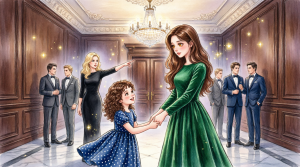
About Lily standing in her starry dress with a card that had nearly ended up unopened because a grown woman didn’t want a child in her photographs.
“Tell the truth,” I said.
He asked whether Lily and I would come back into the ballroom.
I almost refused.
Then Lily touched my arm and whispered, “Can Grandpa have my card at the party?”
So I said, “We’ll stand in the back.
That’s all.”
Dad went ahead of us.
By the time we reentered, the string quartet had gone silent and most of the guests were seated again, murmuring.
Word had already traveled.
It always does.
I felt eyes slide toward me and away.
I kept my hand on Lily’s shoulder and my own shoulders square.
Dad stepped to the podium without his prepared note cards.
He looked out at the room for a long moment before he spoke.
“I was supposed to give a speech tonight about forty-two years of work,” he said.
“About projects, partners, deadlines, and the honor of a long career.
But before I say anything about that, I need to acknowledge something far more important.
My

