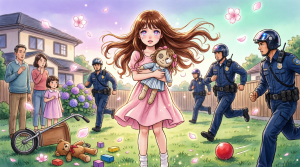
Part 6
When Mia was eight, she asked me to tell her the story.
Not the grown-up version with court dates and legal words and psychological frameworks.
The kid version.
The version her brain could hold.
We were sitting on the couch, the TV muted, rain tapping the windows. Mia had been reading a book where the character got trapped in a cave, and she’d stiffened when the illustration showed darkness.
She set the book down and looked at me with serious eyes.
“Mom,” she said, “why Grandma do that?”
My chest tightened. The question had waited years, like a seed that finally pushed through soil.
I took a breath. “Grandma made a very bad choice,” I said carefully. “She didn’t know how to handle her feelings when you were upset. And she did something dangerous.”
Mia’s fingers twisted her shirt. “Was I bad?”
“No,” I said instantly, and I moved closer. “You were never bad. You were scared and crying because you needed help. That’s what kids do. Grown-ups are supposed to help.”
Mia swallowed. “But she didn’t.”
“No,” I said softly. “She didn’t.”
Mia stared at the floor. “Did Daddy know?”
The question hit harder.
I chose honesty without cruelty.
“Daddy didn’t understand how serious it was at first,” I said. “And that hurt, because you deserved everyone to protect you.”
Mia’s eyes filled. “But you did.”
“Yes,” I said, voice thick. “I did.”
Mia leaned into me and whispered, “I’m glad you came.”
“I will always come,” I promised, and for once the promise didn’t feel like hope. It felt like truth backed by years of showing up.
That same year, Jackson’s supervised visits became less frequent, not because I blocked them, but because he stopped scheduling them consistently. He’d cancel. He’d reschedule. He’d show up late and blame traffic.
Each time, Mia reacted with a strange mix of relief and sadness. Kids can miss someone and still not feel safe with them.
Rebecca said we could petition to reduce visitation due to inconsistency. I asked Mia what she wanted.
“I don’t like going,” she said quietly. “But I don’t want him to be mad.”
That sentence broke my heart.
I sat her down and said, “Your job is not to manage grown-ups’ feelings. Your job is to be a kid.”
Mia nodded, but I could see how deep the old lesson ran: grown-up emotions are dangerous, and you have to be careful.
We went back to court. The judge adjusted the visitation schedule and required Jackson to complete parenting education and individual counseling if he wanted expanded access. Jackson agreed in court, then followed through halfway, the way he did everything when it required uncomfortable accountability.
Meanwhile, Ethan became something steadier in our lives. He didn’t replace Mia’s father. He didn’t pretend he could. He became a safe adult presence who didn’t make Mia’s trauma about himself.
One day, Mia asked Ethan, “Do you have secrets?”
Ethan blinked. “Like… what kind of secrets?”
“Like closets,” Mia said bluntly.
Ethan’s face softened. He crouched so he was level with her. “I don’t keep kids in closets,” he said gently. “Ever. And if you’re scared, you can tell me. I’ll listen.”
Mia studied him, then nodded. “Okay,” she said, like she was granting him a tiny piece of trust.
Later that night, Ethan and I sat on the balcony while Mia slept. The air was cool, the city lights distant.
“I don’t know how you did it,” Ethan said quietly. “The way you fought. The way you held it together.”
“I didn’t hold it together,” I admitted. “I just… kept moving.”
Ethan nodded. “That’s what people don’t understand. Survival isn’t heroic. It’s relentless.”
His words made something loosen in me, because they didn’t romanticize what I’d been through. They simply named it.
A few months later, Ethan asked me to marry him.
I didn’t say yes right away. Not because I didn’t love him, but because I’d learned the cost of ignoring instinct.
I talked to Mia about it, in a way that didn’t put pressure on her. I asked how she felt.
Mia thought hard, then said, “Ethan makes pancakes. And he doesn’t slam doors.”
I laughed through tears. “That’s true.”
Mia added, serious, “If you marry him, will he live here forever?”
“As long as we want,” I said.
Mia nodded. “Okay,” she said simply. “Then yes.”
So I said yes too.
We married in a small ceremony with Mia as the flower girl, tossing petals with solemn focus. My mother cried. Ethan’s parents hugged Mia like she was already family. Even Rebecca came, smiling like she’d seen too much pain not to celebrate joy when it appeared.
Jackson didn’t come. He sent a stiff email through his attorney. It didn’t matter.
Our home became a place built on different rules.
No forced smiles.
No pretending harm didn’t happen.
No loyalty that required silence.
Mia grew into a girl who could name her feelings and ask for what she needed. She still preferred her bedroom door cracked, still kept a small flashlight by her bed, but she also laughed easily, played loudly, and took up space without apology.
Sometimes I’d catch her standing in front of a closet door, staring, like a memory tugged at her.
Then she’d open it, look inside, and close it again—slowly, on her terms—and walk away.
A scar, managed.
A fear, faced.
A child, safe.
Part 7
When Mia turned ten, we moved again—this time not because we were fleeing anything, but because we wanted more space. A backyard. A dog. A place that felt like a future instead of a recovery plan.
On moving day, Mia insisted on being in charge of the “door rules.” She taped a handwritten sign to the inside of her bedroom closet: Doors close gentle. Ask before closing.
Ethan read it and nodded solemnly. “Yes, ma’am.”
Mia smiled, pleased.
The dog came later: a golden retriever mix Mia named Sunny because, she said, “He looks like light.”
Sunny followed Mia everywhere, especially at night. The first time Mia had a nightmare in the new house, Sunny jumped onto her bed and licked her cheek until she laughed, half crying, half giggling. Ethan stood in the doorway, hands in his pockets, giving her space while still being present.
I watched and felt grateful in a way that almost hurt.
Because I knew how easily life could have gone differently.
That year, Lorraine tried again.
Not directly. Not legally, because the law didn’t favor her anymore. She tried the oldest method in the world: guilt through distance.
A letter arrived addressed to me. No return address, but I recognized the handwriting immediately—sharp, dramatic loops like she was always signing her name on a charity gala list.
My stomach tightened. I didn’t open it at the kitchen table. I didn’t open it near Mia. I took it to my bedroom and shut the door softly.
Inside was a three-page monologue about forgiveness.
Lorraine wrote about how time heals.
How families should move on.
How she’d “paid her debt.”
How she “missed her granddaughter.”
How I was “cruel” to keep Mia away.
Not one sentence said: I locked her in a closet and I was wrong.
Not one sentence asked about Mia’s feelings.
The letter was about Lorraine’s hunger, Lorraine’s loss, Lorraine’s pain.
I folded it back up, hands steady. I didn’t feel the old rage. I felt clarity.
I gave it to Rebecca, who handled it the way she handled everything Lorraine touched: efficiently and without emotional drama. A cease-and-desist followed. Another warning that any contact could trigger legal consequences.
Lorraine disappeared again.
Mia never knew about the letter, and I didn’t feel guilty for that. Some truths aren’t helpful for children. Mia already carried enough.
Jackson, meanwhile, drifted closer to irrelevance. His visits remained supervised until Mia was old enough for the court to consider her preference. When she was twelve, she finally said what she’d been circling for years.
“I don’t want to go,” she told me, quiet but firm.
“Okay,” I said.
She searched my face. “You’re not mad?”
“I’m proud,” I said. “Because you’re listening to yourself.”
We went to court. Mia spoke privately with the judge. Afterward, the judge adjusted the arrangement: Jackson could request contact, but Mia could refuse. No pressure. No forced visits. If Jackson wanted a relationship, he had to earn trust, not demand access.
Jackson’s face in the courtroom looked empty, like he’d been waiting for someone to hand him his daughter back without requiring change.
He never really changed.
He sent birthday gifts sometimes. Cards with vague love. Messages about missing her. Nothing that acknowledged how he’d failed her when she needed him to choose her.
Mia accepted the gifts politely, then put them away. She didn’t cry. She didn’t rage. She simply treated the relationship like what it was: a door she could open or close, on her terms.
At thirteen, Mia joined a theater club and took to the stage like she’d been born there. She played bold characters, loud characters, brave characters. She loved the way acting let her step into stories where fear could be transformed into something else.
After one performance, she came offstage glowing, cheeks flushed, eyes bright.
Ethan hugged her and said, “You were incredible.”
Mia grinned. “I know,” she said, and I laughed because confidence used to feel dangerous in our world. Now it felt normal.
That night, Mia and I sat on the porch while Sunny snoozed at our feet. The air was warm, and the neighborhood sounded like ordinary life—sprinklers, laughter, distant music.
Mia stared into the yard for a long time before speaking.
“I still remember the closet,” she said quietly.
My chest tightened. I didn’t interrupt. I didn’t rush to fix it.
“It was dark,” she continued. “And I thought… I thought you forgot me.”
I swallowed hard. “I didn’t,” I said softly. “I never did.”
Mia nodded, eyes shiny. “I know. But that’s what it felt like.”
I reached for her hand. “That makes sense,” I said. “Your feelings were real.”
Mia squeezed my hand. “But then you came,” she said. “And now… when I get scared, I remember that.”
I blinked fast, trying not to cry.
“You were brave,” I told her.
Mia shrugged, teenage-style, like bravery was embarrassing. “I was three. I just cried.”
“You survived,” I said. “And you learned how to heal. That’s brave.”
Mia looked at me, and in her eyes I saw something I hadn’t expected when all of this began.
Peace.
Not the kind of peace that forgets.
The kind that remembers and still chooses life.
Part 8
Mia’s high school years moved faster than I was ready for. One day she was a kid with a nightlight and a flashlight by her bed. The next she was a teenager with opinions sharp enough to cut through nonsense, a driver’s permit, and a future that didn’t revolve around fear.
She still disliked dark, enclosed spaces, but she handled it like a person who’d learned tools. If a movie scene made her uncomfortable, she said so. If a friend suggested hiding in a tight space during a game, she declined without apology. If a teacher closed a classroom door too hard, she took a breath and kept going.
She didn’t pretend the scar didn’t exist.
She simply refused to let it decide everything.
When Mia was sixteen, she wrote a personal essay for a scholarship application. She didn’t show it to me first. She just handed me a printed copy one evening and said, “I need you to read it. And don’t freak out.”
I tried to smile. “I’m not a freak-out person,” I lied.
The essay began with a broken doll on a porch.
My throat tightened.
She wrote about trauma in a way that stunned me—not dramatic, not thirsty for pity, but honest and clear. She wrote about fear and control. She wrote about how some adults demand forgiveness to avoid consequences. She wrote about how real love looks like showing up, again and again, without demanding comfort.
She didn’t name Lorraine. She didn’t name Jackson. She didn’t need to.
The essay ended with a sentence that made me set the paper down and press my hand over my mouth.
I want to be the kind of person who unlocks doors.
I looked up at Mia, eyes burning.
Mia watched me carefully. “Too much?” she asked.
“No,” I whispered. “It’s… incredible.”
Mia shrugged like it didn’t matter, but her eyes softened. “I didn’t want it to own me,” she said.
I nodded. “It doesn’t,” I said. “You own it.”
Mia won the scholarship.
The day the email arrived, she yelled so loud Sunny barked, Ethan cheered, and my mother cried on the phone. Mia laughed and said, “Grandma, stop crying, you’re gonna make me cry.”
My mother sniffed. “I’m allowed,” she said. “You’re amazing.”
It was a different kind of family now. One built on chosen steadiness. One where Mia’s safety wasn’t negotiable.
Then came the moment I knew we’d truly reached the far side of the story.
Mia got invited to a friend’s birthday party at an escape room.
She announced it at dinner like it was no big deal.
Ethan froze mid-bite. I felt my stomach drop.
Mia saw our faces and rolled her eyes. “I know,” she said. “Closets. Doors. Dark. I get it.”
I forced my voice calm. “You don’t have to go,” I said. “No one will think less of you.”
Mia leaned back in her chair, thinking. “I want to go,” she said finally. “But I want to check it out first. Like… see the room. Make sure there’s a way out. Make sure I’m not locked in for real.”
My heart swelled with pride so intense it hurt.
“That’s a smart plan,” Ethan said carefully.
Mia nodded. “And if it feels bad, I’ll leave,” she added. “Because that’s allowed.”
“Yes,” I said, voice thick. “It’s allowed.”
We went to the escape room place the day before the party. The manager showed Mia the room and explained that doors were never truly locked, that staff could open everything instantly, that safety was the priority. Mia asked questions like a lawyer. She checked the emergency exits. She tested the door.
Then she looked at me and said, “Okay. I can do it.”
At the party, she did it.
She came home glowing, telling stories, laughing. She threw herself onto the couch and said, “It was actually fun.”
Ethan exhaled like he’d been holding his breath for hours.
I went to my room and cried, silently, because sometimes healing looks like a teenager solving puzzles in a room that would have once triggered panic, and that’s the kind of miracle people don’t put in movies.
Later that year, Jackson sent Mia a letter.
Not a card. A letter.
Mia read it at the kitchen table, expression unreadable. Then she slid it across to me.
It was longer than his previous ones. It said he missed her. It said he regretted “how things happened.” It said he wished he could go back.
It still didn’t say: I should have protected you.
It still didn’t say: I was wrong.
Mia watched me. “Do you think he even gets it?” she asked.
I chose honesty. “I think he gets that he lost something,” I said. “I don’t know if he gets why.”
Mia nodded slowly. “That’s sad,” she said.
“It is,” I agreed.
Mia picked up the letter again. She folded it carefully. Then she said, “I don’t want to see him right now.”
“Okay,” I said.
Mia looked relieved. “But maybe someday,” she added, thoughtful. “If he ever actually says the truth.”
I blinked, surprised by how generous she still was. How she could hold boundaries without becoming hard.
Mia stood and stretched. “I’m going to walk Sunny,” she announced.
As she grabbed the leash, she paused at the closet door in the hallway. She opened it, grabbed her coat, and closed it gently.
Door closes gentle. Ask before closing.
She did it without thinking.
Because safety had become habit.
Part 9
Mia left for college at eighteen with Sunny’s fur still on her hoodie and a confidence that felt like sunlight. She hugged me tight, hugged Ethan, hugged my mother, and promised she’d call.
I watched her walk away and felt the old fear flicker—because leaving used to mean danger in our story.
But then I reminded myself: this leaving was different.
This leaving was chosen.
This leaving was supported.
This leaving came with a home to return to.
Her dorm room had bright windows. She sent photos. She joined a theater group, then a campus advocacy club focused on child safety and trauma-informed care. She didn’t join because she was broken. She joined because she wanted to help unlock doors for other people.
One night, during her first semester, she called me and said, “Mom, can I tell you something weird?”
“Always,” I said.
“I talked about it,” she said, voice quieter. “The closet. In a meeting. I didn’t cry. I didn’t freak out. I just… said it. And no one looked at me like I was damaged. They just listened.”
My throat tightened. “How did that feel?” I asked.
“Free,” she said. “Like it’s a chapter, not the whole book.”
I leaned back against the couch and closed my eyes. “I’m proud of you,” I said.
“I’m proud of you too,” Mia replied, and I could hear the smile in her voice. “You’re the reason I’m not scared of everything.”
After we hung up, Ethan sat beside me and said, “She’s incredible.”
“She is,” I said. “And she shouldn’t have had to be.”
Ethan nodded. “No,” he said softly. “But she is.”
A year later, Lorraine died.
The news came through Rebecca, because Lorraine’s attorney had tried one last time—one last reach—asking if Mia would attend the funeral, arguing it would provide “closure.”
Rebecca’s email was simple: Lorraine passed away; no action required; restraining order dissolves upon death; do you want me to respond or ignore?
I stared at the screen for a long time.
When I told Mia, she went silent.
I braced for tears or anger or relief.
Instead, she said quietly, “I don’t feel anything.”
“That’s okay,” I told her.
Mia took a deep breath. “I don’t want to go,” she said.
“You don’t have to,” I replied.
Mia nodded. “Okay,” she said, and then she added, almost to herself, “I think… she already made her choice. A long time ago.”
We didn’t attend the funeral.
We didn’t send flowers.
We didn’t perform forgiveness for an audience.
We simply continued living.
A month after Lorraine’s death, Jackson reached out.
Not through his attorney this time. He emailed Mia directly, using an address he must have found through old records. The message was long and messy, filled with grief and regret. He wrote about his mother’s death. He wrote about wishing he’d done things differently. He wrote about missing Mia.
And this time—finally—he wrote a sentence that mattered.
I should have protected you. I didn’t. I am sorry.
Mia read it, then called me.
“I don’t know what to do,” she said, voice shaking.
“You don’t have to do anything right away,” I said. “What do you want?”
Mia was quiet for a long moment. Then she said, “I want to respond. Not to make him feel better. For me.”
“Okay,” I said gently. “What do you want to say?”
Mia exhaled. “I want to say I remember. And I want to say I’m okay. And I want to say… I won’t pretend it was small.”
I swallowed hard. “That sounds honest.”
Mia wrote her response. She didn’t show it to me before sending, but later she read it out loud over the phone.
She wrote that she remembered the closet.
She wrote that she remembered how long it felt.
She wrote that she remembered him calling it a mistake.
She wrote that she needed him to understand that minimizing pain is another kind of harm.
She wrote that she wasn’t ready for a close relationship, but she was open to slow conversation if he continued therapy and proved he could prioritize her wellbeing over family loyalty.
Then she ended with a sentence that made my chest ache.
I survived because my mom came. If you want to be in my life, you have to be someone who comes too.
Jackson replied a week later with proof of therapy enrollment and a request for a supervised phone call—not legally supervised, but emotionally supervised, with clear boundaries.
Mia agreed.
The first call was awkward. Jackson cried. Mia didn’t. She spoke calmly. She asked direct questions. Jackson answered without excuses. When he tried to drift into self-pity, Mia stopped him.
“This isn’t about making you feel better,” she said. “This is about whether you can be safe.”
I sat on my couch listening to Mia’s side of the conversation, tears in my eyes, because I could hear how strong she’d become—not the forced strength of survival, but the steady strength of self-respect.
Over the next year, Mia and Jackson rebuilt something small and careful. Not a fairy-tale reunion. Not a full repair. A cautious bridge.
Mia never forgot what happened. She didn’t need to. She didn’t forgive Lorraine. She didn’t rewrite history to make other people comfortable. She simply chose what was healthy.
When Mia graduated college, she walked across the stage wearing honors cords and a smile that looked like sunrise. She spotted me in the crowd and waved. Ethan cheered. My mother cried. Sunny, older now, waited at home with a wagging tail and gray around his muzzle.
That night at dinner, Mia set a small box on the table.
“I have something for you,” she said, looking at me.
I opened it and found Rosie.
Not the broken Rosie from that day—though I still had her in a box in my closet—but a repaired version. Mia had found someone online who restored old rag dolls. Rosie’s seam was sewn cleanly. Her dress was mended. The stuffing was smooth again.
Rosie looked whole.
Mia watched my face. “I know it doesn’t change what happened,” she said quietly. “But I wanted… something that says we can fix things without pretending they never broke.”
My throat tightened so hard I couldn’t speak for a moment.
Finally, I whispered, “Thank you.”
Mia reached across the table and squeezed my hand. “You saved me,” she said simply.
I shook my head, tears spilling. “I came for you,” I said. “You saved yourself too.”
Mia smiled, and in that smile was the clearest ending our story could have.
Lorraine’s choice had been to lock a child away so she could buy clothes.
Jackson’s early choice had been to defend his mother’s comfort instead of his daughter’s safety.
Cassandra’s choice had been to treat a toddler’s fear like an inconvenience.
My choice had been to trust the broken doll on the porch and the silence behind the door.
To call for help.
To refuse to be gaslit into waiting.
To walk away from a marriage that demanded I tolerate danger.
To rebuild a home where safety was normal.
And Mia’s choice—over and over—had been to heal without denying the scar.
In the end, the house that shocked everyone didn’t define us.
The unlocked doors did.
THE END!