“We have everything we need,” she said, her voice calm and crisp on the line. I could picture her—steel-gray bob, wire-rim glasses, the kind of woman whose very presence made people sit up straighter. She’d been my mom’s lawyer, but also her friend; I remembered her bringing fresh-baked banana bread to the hospital, slipping me twenty-dollar bills for snacks when she thought Mom wasn’t looking.
“The trust was executed cleanly and with full capacity,” she continued. “Your father knew exactly what he was signing at the time. The beach house has been separate from his other assets since your mother’s passing. It is not marital property. Legally, it belongs to you and only you.”
“But Victoria says he transferred it,” I said, even though I knew the answer.
“Legally,” Margaret repeated, “he cannot transfer what he doesn’t own. Whatever paperwork he signed with her is invalid where the beach house is concerned. At best, she’s confused. At worst…” I could hear the faint clack of keyboard keys on her end. “At worst, she deliberately misled him.”
We walked through every step—who I should talk to, what to bring, what to say and, more importantly, what not to say. She’d already contacted the local authorities and sent them copies of the trust and deed.
“The local police have been notified,” Margaret said. “Officer Martinez is expecting you. He has copies of the documents and understands that you are the legal owner. If there’s any trouble, he’ll assist.”
I pictured Victoria’s face when a uniformed officer calmly informed her she’d banned the wrong person from the property. A tiny flare of satisfaction warmed my chest.
One more thing,” Margaret added. “I’ve documented all of Victoria’s attempts to access the trust over the years. The judge will be very interested if this ever goes to court.”
A memory surfaced: Victoria hovering near Mom’s desk after the funeral, her fingers brushing the locked drawer with my mother’s files. Or the time she’d asked an oddly casual question over dinner: “So, Alexandra, what ever happened with that old beach property paperwork? Your mother always hated dealing with that stuff.” I’d shrugged and said something noncommittal, watching her eyes narrow thoughtfully.
It hadn’t been paranoia. Mom had seen it. Margaret had seen it. I just hadn’t wanted to see it as clearly.
We wrapped up the call, and I walked to my living room window. Outside, the sky had shifted from fiery orange to deep purple, city lights sparkling like a second constellation below. Somewhere out there, people were going about their lives, unaware that in one small apartment, a battle line had been quietly drawn over a house by the sea.
My phone buzzed again.
Victoria.
I’m having your mother’s roses removed from the garden tomorrow, her text said. Time to let go of the past.
For a moment, I couldn’t breathe.
I could see the roses clearly: deep crimson, planted along the front path, dancing in the sea breeze. Mom had cared for those bushes like they were old friends. She’d talked to them while she pruned, humming under her breath, fingers stained green. She’d given cuttings to neighbors, saying, “So a little piece of our home can bloom at yours.”
Time to let go of the past.
I didn’t reply. There was nothing I could say that would matter to her. She wasn’t trying to inform me. She was trying to hurt me. To mark the house as hers by tearing out one of the last tangible pieces of Mom.
Instead, I set my phone aside and went to my bedroom.
I packed.
I packed jeans and sweaters and the old navy-blue hoodie Mom had once stolen from my closet, worn all weekend at the beach house, and then reluctantly returned after we’d argued playfully about “ownership.” I packed the manila envelope with the trust documents and the deed, tucking them carefully between two thick hardcover books. I slid a worn photo of Mom and me on the beach—me about seven years old, hair in tangled braids, her in a floppy hat—into the inside pocket of my bag.
As I zipped the suitcase closed, Mom’s voice popped into my mind again, from that last summer we’d spent together at the house.
“Sometimes, sweetheart,” she’d said, as we’d sat on the porch watching the sun slip beneath the horizon, turning the water molten gold, “the best revenge is simply standing your ground and letting others realize how badly they’ve underestimated you.”
I hadn’t fully understood it then.
I did now.
Tomorrow, Victoria would learn exactly what that meant.
The early morning fog in coastal Massachusetts didn’t roll—it wrapped. It moved like something alive, winding around telephone poles and dunes, blurring streetlights into hesitant halos. As my Uber wound its way along the familiar coastal road, I pressed my forehead against the cool window and inhaled deeply, almost able to smell the ocean through the glass.
The landscape shifted from town to sea. One moment there were clapboard houses and weathered storefronts; the next, the horizon opened up, and there it was: a sheet of gray-green water, restless and infinite.
Then, through the thickening mist, I saw it.
The house.
My heart twisted.
From a distance, it looked both completely unchanged and deeply wrong at the same time. The wraparound porch was still there, hugging the front and side of the house like a protective arm. The weathered shingles, once a proud gray, looked freshly painted, losing some of their charm in the glossy uniformity. The white railing had been replaced with something sleeker, more modern, and utterly out of place.
The car pulled into the crushed-shell driveway that crunched under the tires.
And parked right smack where Mom’s old garden shed used to be—where she’d kept bags of soil, chipped terracotta pots, and a radio permanently tuned to classic rock—was a bright red Mercedes.
Of course.
New security cameras peered from the corners of the house like watchful, judging eyes. A large NO TRESPASSING sign was hammered into the ground not far from the driveway entrance. It was glossy and new, with bold red letters that clashed horribly with the soft, muted tones of sand and sea grass surrounding it.
Perfect, I thought.
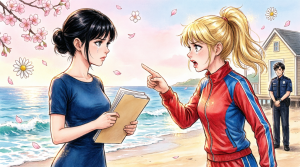
Before I could even open the car door, the front door flew open and Victoria stormed out, the fog swirling dramatically around her as if even nature had been enlisted in her theatrics.
She was wearing designer workout gear, all sleek black and neon accents, her blond hair pulled back into a tight ponytail that didn’t dare move in the breeze. The outfit looked like it belonged in some elite city gym, not on the front steps of a weather-beaten beach house that had seen more fishing nets and sandy feet than yoga mats.
Behind her, Lily emerged, phone in hand, camera aimed straight at me.
Of course she was filming.
“I told you you’re not welcome here!” Victoria shrieked as she marched down the shell-lined path toward the car, her sneakers crunching dramatically. “Get back in that car and leave, Alexandra. Right now. I’m calling the police.”
“Please do,” I replied, opening my door calmly.
The ocean air hit me like a drug—salt and damp and the faint smell of seaweed. My lungs expanded like they hadn’t in months. I stepped out, the shells grinding beneath my boots, and pulled my suitcase from the trunk.
“In fact,” I added, straightening and meeting her furious gaze coolly, “I already called them myself. They should be here any minute.”
For a second, she faltered. It was quick—just a hitch in her step, a flicker in her eyes—but I saw it. Then her face tightened, her lips pressing into a razor-thin line.
“You entitled little—”
The distant wail of sirens cut her off.
We all turned as two patrol cars emerged through the fog, lights quietly spinning. They pulled into the driveway, careful not to block anyone in, and parked.
Lily zoomed in with her phone, no doubt already thinking of captions.
One of the officers stepped out. I recognized him from the brief conversation we’d had the night before.
“Mrs. Harrison,” Officer Martinez said, addressing Victoria as he approached. His dark hair was tucked neatly beneath his cap, his posture professional but not unfriendly. “We received your complaint about a trespasser.”
Victoria thrust a hand toward me like she was presenting evidence in court. “Yes! That’s her. She doesn’t live here. She has no right—”
He didn’t look where she was pointing. Instead, he reached into his jacket and pulled out a folder. “There seems to be a misunderstanding.”
“There’s no misunderstanding,” she snapped, her cheeks flushing. “This is my house. My husband signed it over to me. I told you that on the phone.”
Officer Martinez opened the folder, glanced at the top document, and then looked at me. “Miss Alexandra Parker?” he asked.
“That’s me,” I said.
He nodded. “We reviewed the documents your lawyer sent last night. According to these,” he tapped the folder lightly, “Miss Parker is the legal owner of this property.”
Silence dropped like a stone.
Lily’s phone dipped lower. Victoria blinked once, twice, as if the words had been spoken in another language.
“That’s impossible,” she finally sputtered. “My husband signed the deed over to me last month. We had it notarized. I’ve already started paperwork to—”
I reached into my bag and pulled out the manila envelope, the trust pages already familiar under my fingers. “Dad couldn’t sign over what wasn’t his to give,” I said, keeping my tone level. “Mom put this house in a trust before she died. I’m the sole beneficiary. The beach house has been owned by the trust this entire time.”
“Liar,” Lily muttered, but there was a tremor in it.
Officer Martinez turned the folder slightly, so Victoria could see the top page. “These documents are clear, Mrs. Harrison. This property was placed in an irrevocable trust by the late Mrs. Parker. Her daughter is the beneficiary and legal owner. Your husband’s signature on any later deed regarding this property has no legal effect.”
Victoria opened her mouth. Nothing came out.
“Mom, what is he talking about?” Lily demanded, stepping closer, phone now hanging forgotten at her side.
I watched Victoria’s face carefully. It was like seeing a mask crack. The confident, flawless veneer she always presented to the world splintered in tiny lines around her eyes and mouth.
“This… this is some trick,” she stammered. “Alexandra probably… she probably forged something. James would never—”
“Mrs. Harrison,” Officer Martinez interrupted, his voice remaining polite but firm. “The documentation comes directly from the office of Margaret Sullivan, who has served as the family’s attorney for many years. We verified it independently. Miss Parker has every right to be here. Any attempt to bar her from entering her own property could result in legal consequences.”
“Legal consequences?” Lily repeated, eyes darting between us.
Victoria rounded on me, fury reignited now that she had somewhere to direct it. “You manipulative little—”
She took a step toward me, her hand lifting as if to jab a finger in my face, but Officer Martinez smoothly stepped between us.
“I suggest you step back and contact your lawyer,” he said calmly. “Any physical threats will be taken seriously.”
For a moment, the only sound was the distant crash of waves and the soft hiss of the wind moving through the dune grass.
“JAMES!” Victoria suddenly screamed, throwing her head back toward the house. “Get out here now!”
The front door opened again, slower this time.
My father walked out onto the porch.
The last couple of years seemed to have settled heavily on his shoulders. His once-dark hair was now mostly gray, thinning at the crown. His posture, always straight and confident when I was a little girl watching him fix things around the house, was slightly bent, as if he’d been carrying something too heavy for too long.
His eyes scanned the scene—the patrol cars, the uniformed officers, Victoria vibrating with rage, Lily clutching her phone like a lifeline, and finally me, standing with my suitcase by the driveway.
“Alexandra?” he said, his voice small against the roar of the ocean behind him.
“Dad,” I replied. “Did you even read what you were signing when Victoria asked you to transfer the house?”
He looked at Victoria, then at me. His mouth opened and closed. “She said… she said it was just a formality. That you didn’t care about the house. That you were always too busy with your life in the city to maintain it, to come up here anymore. She said it would be easier if—”
“Too busy, huh?”
I pulled my phone from my pocket and swiped through the photos. “These are from last year,” I said, stepping forward so he could see. “When I came up to meet with the contractors about the roof.” I swiped. “The year before that, when I hired the local painter to fix the shutters. The one before that—new septic system inspection. Every year, Dad. The trust has been covering maintenance and taxes since Mom died. I’ve been coordinating everything with Margaret.”
I turned my gaze to Victoria. “That’s why you never managed to switch the utilities into your name, isn’t it? You never had the authority.”
Something like panic flashed across her face, quickly masked by anger.
“You think you’re clever,” she hissed. “You think hiding behind legal technicalities makes you better than us. This house should have been ours. James and I are the ones who made this a real family.”
I laughed. I couldn’t help it. The sound surprised even me. It wasn’t hysterical; it was quiet and exhausted and edged with something sharp.
“A real family,” I repeated. “Is that what you call years of excluding me? Of telling people I couldn’t make it to events I wasn’t even invited to? Of trying to rip out Mom’s roses and erase every trace of her from this place?”
Lily flinched.
“Stop it,” she snapped. “You’re making her sound like some kind of monster.”
I looked at her—really looked—for the first time that morning. Without the filter of social media, without the glow of a carefully curated photo, she looked younger. The eyeliner she usually wore so precisely smudged faintly under her eyes. Her mouth was set, but there was uncertainty lurking there now.
Officer Martinez closed the folder. “I’m going to have to ask everyone to keep things civil,” he said. “Legally, the situation is clear. This is Miss Parker’s property. If there is any dispute about previous paperwork, that will have to be handled between lawyers. For now, no one has the right to prevent Miss Parker from entering, staying at, or managing this property. Understood?”
My father nodded slowly. Lily looked at the ground.
Victoria glared at him, mouth twisted. “Say something,” she demanded.
He looked at her for a long time. Then he looked back at the house, at the porch, at the roses along the walkway—some of them clearly recently disturbed, their soil dark and freshly turned, as if someone had started digging them up and then stopped.
Finally, he turned to me.
“Is it true?” he asked, almost in a whisper. “That your mother… protected the house? That she—”
“She put it in the trust three months before she died,” I said. “You were there when she signed the papers, Dad. You probably didn’t want to think about what it meant at the time, but you were there.”
His shoulders sagged.
“I didn’t understand,” he murmured. “I just… I didn’t want to think about losing her. And later, when Victoria told me we needed to deal with the property, I… I trusted her. I thought she was just trying to help.”
Victoria made a choking sound. “So now I’m the villain?” she demanded. “After everything I’ve done for this family? After all the years I’ve—”
“Mrs. Harrison,” Officer Martinez cut in, a hint of steel in his voice now, “if you continue to raise your voice, I’ll have to ask you to step back from the property until you’ve spoken to your lawyer.”
Her jaw clenched.
A second car pulled into the driveway then—sleek, dark, unmarked. A man in a suit stepped out, briefcase in hand. Victoria’s lawyer, judging by the way she whirled toward him like he was reinforcements arriving on a battlefield.
They spoke in hushed tones not far from the porch. I watched his face carefully as she waved her hands, gesturing at me, at the officers, at the house. He opened the folder Officer Martinez handed him, scanned the trust documents, frowned, flipped pages.
His shoulders sank.
He looked at Victoria and started speaking, his expression measured, controlled. She went pale. Then flushed red. Then pale again.
I didn’t need to hear the words to know what he was saying.
The trust was ironclad.
Any paperwork she’d had my father sign was meaningless in the face of it.
Not only did she not own the house, but her attempts to claim ownership might have crossed the line into something ugly—fraud, coercion, manipulation of a widower still staggered by grief.
I turned away from them and looked at the house.
Mom’s house.

