something in me hardened into shape.
I asked her whether she remembered learning to swim in the water behind that house while Roberto held both arms out because she was afraid of the tide.
I asked whether she remembered him teaching her to drive in that Volkswagen in the supermarket parking lot after closing time, both of them laughing because she kept stalling it.
I asked whether she remembered him changing the spark plugs with her when she was sixteen so she could say she knew how engines worked.
She started crying before I finished.
Eduardo tried to interrupt, but I lifted my hand and for once in my life he stopped speaking.
I told Angela that desperation explains many things but it does not excuse theft, and it certainly does not excuse betrayal packaged as efficiency.
I told her that what broke me was not even the attempted sale.
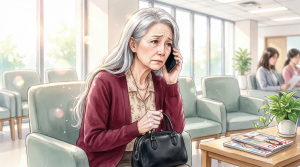
It was the fact that she had called while I sat in a doctor’s office and spoke to me as if I were already irrelevant to my own life.
She covered her face.
I felt grief in that moment, but not the grief of losing Roberto.
That grief had been clean.
This was the grief of seeing the child I had raised and realizing I could not save her from becoming the person she had chosen to be.
The detective entered a few minutes later with another officer.
Angela looked stunned, as though consequences were a language she had never been taught to hear.
Eduardo became angry then, loudly angry, the kind of man who mistakes volume for innocence.
He said Roberto had manipulated everyone.
He said the house would have gone to Angela eventually anyway.
He said families should not call the police on families.
The detective listened without expression and then informed both of them that attempted fraudulent transfer of property, forgery, and exploitation of an elderly victim were not family misunderstandings.
They were crimes.
Over the next weeks, the details settled into place.
The buyer of the beach house backed out once the fraud was uncovered, grateful to recover the escrowed funds before the closing.
The dealer returned the Volkswagen in the same condition it had been taken, right down to the faded air freshener I had been meaning to remove for years.
Angela and Eduardo were charged.
Eduardo, who had initiated most of the paperwork and had a previous history of financial misconduct, fought the charges at first and only worsened his position.
Angela cooperated late and received less severe treatment, but the case moved forward all the same.
I wish I could say that after the confrontation my daughter ran into my arms, confessed everything with full honesty, and began the difficult work of becoming better.
Life did not give me that kind of neatness.
What it gave me instead was a series of documents, court dates, and long afternoons in which I had to learn that love and access are not the same thing.
Angela wrote me letters from her attorney’s office asking me to show mercy.
Some were sincere.
Some were strategic.
Most were probably both.
I answered only once.
I wrote that mercy did not require me to hand back the knife someone had used on me.
Six months later, the case
ended.
Eduardo accepted a plea after evidence from the emails, forged documents, and recorded conversations left him little room to maneuver.
Angela received probation, community service, and a restitution order for the legal fees and related costs.
More painful to her than any of that, I think, was the will clause.
Roberto’s scholarship fund was established exactly as he had directed.
The first year it paid tuition for two students in the automotive technology program at the community college.
Roberto would have liked that.
He always trusted hands that knew how to repair things.
As for me, I did not emerge from it triumphant in the childish way people imagine justice.
I emerged tired, wiser, and oddly lighter.
Evelyn helped me update my own will.
I changed my locks.
I learned where every deed, title, account number, and insurance paper lived.
I stopped apologizing for protecting myself.
The first time I signed a document without explaining to anyone why I had the right to sign it, my hand shook.
The second time it did not.
A month after the case closed, I drove the Volkswagen to the beach house alone.
I had avoided the place since Roberto died because I could not bear the emptiness of it.
But when I turned onto the familiar road and saw the sea flashing between the pines, I felt him beside me in the gentlest way, not as a ghost, not as a wound, but as memory properly held.
The house needed paint.
The porch steps squeaked.
The wind chimes he had insisted on hanging by the kitchen window still sounded slightly out of tune.
It was perfect.
I made coffee with milk the next morning and put toast on the little blue plate I still carried back and forth because some rituals are too intimate to abandon.
I took breakfast onto the porch and looked at the Volkswagen parked under the tree where Roberto always left it.
For a long time I simply sat there listening to the waves and the faint rattle of the windows.
There was no dramatic revelation left.
No secret account waiting to be uncovered.
No final twist.
The truth was simpler than that.
What Roberto left behind was not just a trust, a title, or a clever legal trap.
He left me evidence.
He left me options.
He left me a line I could finally draw.
Most of all, he left me proof that being loved well does not mean being sheltered from reality.
It means being prepared to face it when it arrives.
I still think of Angela.
Of course I do.
A mother does not amputate love just because love has become dangerous.
But I no longer confuse love with surrender.
I hope she changes.
I hope she learns what cannot be bought back once sold.
I hope one day she understands that what I protected was not merely property.
It was the dignity of my own life.
Whether she understands or not, I am no longer waiting for that understanding to begin my peace.
Last week, nearly a year after that phone call, I stood in the garage polishing a little patch of chrome on the Volkswagen while afternoon light fell across the floor in long gold bars.
My hands smelled faintly of metal and
wax.
I suddenly thought of Roberto on a Sunday, humming to himself, arguing with an engine as though it were an old friend.
I laughed out loud, alone, and it did not feel lonely.
Then I locked the garage, carried my coffee to the porch, and watched the evening settle over the water.
My daughter had tried to sell my beach house and my car while I was still alive to miss them.
She failed.
The house is still mine to keep or sell when I choose.
The car is still under the tree.
Roberto’s scholarship is helping young people start honest lives.
And I am still here, 71 years old, drinking coffee from a blue cup, no longer confused about the difference between family and possession.
That is how the story ends: not with revenge, not with a reunion, but with a woman who finally understood that her kindness did not have to be the door through which everyone entered.
It could also be the thing she protected most fiercely, and she did.
Perhaps this brought back a feeling you haven’t put into words in a long time. If you feel like sharing, the comments are open for your voice.

