I was sitting in a doctor’s waiting room when my phone rang, and because the number on the screen was my daughter’s, I answered with a little smile.
For months I had been living on crumbs of normalcy, and even a call from Angela felt like proof that the world had not completely broken apart after Roberto died.
I expected her to ask whether I had brought my insurance card or whether I wanted soup later.
Instead, I heard a tone in her voice I had never heard before.
It was calm in the worst way, not loving calm, not thoughtful calm, but the kind of calm people use when they are already done feeling responsible for what they are about to do.
She said, very clearly, that she and Eduardo were leaving for Europe the next day.
Then she said they had sold my beach house and my car because they needed the money.
Then she said goodbye and hung up.
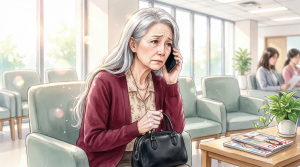
I was sitting in a doctor’s waiting room when my phone rang, and because the number on the screen was my daughter’s, I answered with a little smile.
For months I had been living on crumbs of normalcy, and even a call from Angela felt like proof that the world had not completely broken apart after Roberto died.
I expected her to ask whether I had brought my insurance card or whether I wanted soup later.
Instead, I heard a tone in her voice I had never heard before.
It was calm in the worst way, not loving calm, not thoughtful calm, but the kind of calm people use when they are already done feeling responsible for what they are about to do.
She said, very clearly, that she and Eduardo were leaving for Europe the next day.
Then she said they had sold my beach house and my car because they needed the money.
Then she said goodbye and hung up.
No pause.
No explanation.
No concern about how the words would land.
Just a brutal little announcement dropped into my lap while fluorescent lights buzzed over my head and a child in the corner played with a broken toy truck.
I remember staring at the wall across from me and noticing a water stain shaped like a bird.
I remember hearing someone cough.
I remember thinking that if I stood up too quickly, I might fall.
What I do not remember is breathing.
A nurse called my name a minute later, and I followed her as though my body belonged to a patient stranger I had been instructed to escort down the hall.
The doctor told me my blood pressure was elevated.
He asked whether I had been under unusual stress.
I almost laughed.
My husband had died six months earlier at our breakfast table after kissing my forehead and calling me his love, and now my daughter had just informed me that she had sold the two things in the world most wrapped up in his memory.
But instead of saying any of that, I nodded politely, let him listen to my heart, and accepted a pamphlet about sleep and healthy eating that I never read.
On the bus ride home, I sat by the window and let the city pass in a blur.
That was when I remembered the envelope.
Three days before Roberto died, he had handed me a large manila envelope in the bedroom with an expression so serious that I asked whether he was feeling all right.
He had smiled and said he was fine, then told me to put it in my dresser drawer and open it only if anything happened to him and only when I was ready.
Grief had erased the memory after the funeral.
But Angela’s phone call brought it back whole, like a key turning in an old lock.
When I got home, the house felt unusually quiet, as if it too were listening.
I went straight to our bedroom, opened the dresser drawer, and found the envelope exactly where I had left it under a stack of folded sweaters.
My name was written on the front in Roberto’s slanted handwriting.
Seeing it made my throat close.
I sat on the edge of the bed for a long
moment with the envelope in my lap, then finally broke the seal.
Inside was a letter, a business card, copies of legal documents, and a small brass key taped to an index card.
The business card belonged to an estate attorney named Evelyn Carter.
The key was for our safe-deposit box at the bank.
The letter was several pages long.
I knew the moment I saw the first line that Roberto had written it carefully, perhaps over several nights, perhaps while I slept.
He began by apologizing for leaving me paperwork when what he wanted to leave me was peace.
Then he wrote the sentence that changed everything: he had become worried about Angela and Eduardo.
He explained that during the year before his death, they had started asking too many questions about titles, deeds, account access, and how quickly property could be transferred if one of us became ill.
At first he had answered politely.
Then he had noticed Eduardo lingering over files on his desk, noticed Angela saying things like we were getting older and would not need two houses, noticed a hunger in their tone that had nothing to do with caring for us.
Roberto wrote that he had not wanted to upset me because he knew I would make excuses for our daughter.
He knew me too well.
So instead of arguing, he prepared.
He had transferred the beach house, the Volkswagen, and most of our liquid savings into a trust called the Mar Azul Trust.
I was the lifetime beneficiary.
Nothing in that trust could be sold, borrowed against, or transferred without my in-person authorization in Evelyn Carter’s office.
There was no power of attorney for Angela.
There had never been one.
The original deed and title were in the safe-deposit box.
Copies were attached to the letter.
On a flash drive inside the box, he wrote, there were copies of emails and recordings he believed I might need if anyone ever tried to pressure me, deceive me, or take what was mine.
He ended the letter with words that made me cry at last: I know your heart, Antonia.
It is the kindest thing I have ever known.
Please do not let anyone use that kindness as a crowbar.
I called Evelyn Carter with shaking hands.
She answered on the second ring as if she had been waiting for me.
When I told her who I was, her voice softened.
She said Roberto had met with her several times in the last months of his life and had left very specific instructions.
If I ever called in distress about the beach house, the car, or any pressure from Angela and Eduardo, I was to come to her office immediately with the envelope.
I was there forty minutes later, still carrying the doctor’s pamphlet in my purse like a relic from the version of the day that had ended with that phone call.
Evelyn was in her sixties, silver-haired, sharp-eyed, and kind without being soft.
She spread the documents across a conference table and confirmed what Roberto had written.
The beach house was legally protected.
The Volkswagen title had never left the trust.
Then she looked at me and asked me to repeat, word for word, what Angela had said on the phone.
When I
CLICK HERE TO CONTINUE READING THE NEXT PART 👉: PART 2-SHE SOLD HER MOTHER’S HOUSE—THEN HER LATE FATHER’S LETTER CHANGED EVERYTHING

