family management anyway, so it was smarter to start now.
And because Vanessa had spent years wanting credit for sacrifices she never actually made, she’d swallowed the fantasy that this was finally her chance to become indispensable.
Craig denied half of it, admitted a quarter, and minimized the rest.
It didn’t matter.
He and Vanessa left that afternoon under the deputy’s eye.
The trailer rolled away empty.
The only thing they took was the portable scanner, the printed rate sheets, and the little performance of good intentions they had brought with them.
When the gravel settled and their cars were gone, my mother sat down on the porch steps and cried the way people cry after holding themselves upright for too long.
My father stared at the lake.
I stood in the yard feeling the delayed shake of adrenaline work through my arms.
Then my dad looked at me and asked the question that almost broke me.
Is it still ours?
I went over and knelt in front of him.
Yes, I said.
It is still yours.
Nobody can move in.
Nobody can rent it out.
Nobody can borrow against it.
Nobody can take it with paperwork you didn’t understand.
That’s why I built it the way I did.
He closed his eyes and nodded.
That night, I stayed.
I checked every room, every drawer, every cabinet, partly for inventory and partly because restoring order after a violation is its own kind of mercy.
They hadn’t gotten far.
One lamp moved.
A basket of blankets near the trailer.
Two framed photos taken off the guest-room dresser.
A box of staging décor Craig had brought in sat unopened by the mudroom bench, full of gray vases and neutral fake books that looked like they had been manufactured by a committee allergic to memory.
I carried that box straight to my car.
My mother apologized three times before dinner.
I stopped her each time.
The fourth time, I told her the truth.
This is exactly why I didn’t put paperwork in your hands.
You should never have had to be the wall between this house and people who know how to push.
She cried again, but softer.
My father was quiet for most of the evening.
Later, after Mom went to bed, he and I sat on the porch under the yellow light.
The lake was black glass.
He kept one hand around a mug of tea because the warmth helped with the tremor.
I should have seen it sooner, he said.
You did, I said.
You texted me.
Too late.
No.
Before they got what they wanted.
He sat with that for a while.
Then he said something I had never heard from him in exactly those words.
Thank you for not making me feel foolish.
I looked out at the water because looking at him would have made me cry.
You are not foolish, Dad.
He nodded once.
I know.
But today I felt close.
The next week, I did what I always do when life shows me where the weak points are.
I tightened everything.
I had the attorney send formal cease-and-desist notices to Craig and Vanessa.
We added an occupancy restriction rider to the trust file, not because the old documents were weak, but because clarity can be
its own weapon.
I installed cameras at the driveway and side entrance.
I changed every digital code.
I created a one-page plain-language summary for my parents that said, in giant print, Nobody may move in, manage, rent, borrow against, or alter this property without Riley and our attorney both saying yes in writing.
Then I taped it inside the pantry door.
I also learned Craig had uploaded draft rental photos to two short-term listing platforms under a company profile he created the night before he came to the cabin.
My attorney handled those takedowns before the listings went live.
He had also started a file for a business line of credit using projected cabin income.
That attempt died the second we disputed the authority behind it.
For about a month, Vanessa sent messages that alternated between apology and accusation.
She was sorry.
I had humiliated her.
Craig had pressured her.
I had always hated Craig.
She had only wanted to help.
I was turning our parents against her.
I answered once.
I told her there would be no contact at the cabin, no direct requests to our parents about money or property, and no rebuilding anything until she could tell the truth in one version and stay there.
Then I stopped responding.
Two months later, she left Craig.
I found out because she emailed my mother from a new address and asked if they would meet her with a counselor present.
I expected my parents to say no.
Instead, my mother looked at me over her coffee and said something that reminded me exactly who had carried our family for all those years.
Forgiveness is not the same as access, she said.
So they met her once, with boundaries so clear you could have used them as survey lines.
No requests for money.
No talk of the cabin except to acknowledge what she had done.
No surprise visits.
No keys.
No triangulating through guilt.
Vanessa cried.
She admitted Craig had lied to her about the scale of the debt.
She admitted she had still chosen to believe him because she was desperate to be the daughter who mattered.
She admitted she had told our mother that the cabin was financially unstable because fear made compliance easier.
My father listened.
My mother listened.
When it was over, neither of them rushed to comfort her.
That was new.
Healing, when it came, was slow and ordinary.
No dramatic reconciliation music.
No miracle speeches.
Just consequences, distance, therapy, careful conversations, and a family learning the difference between love and access.
Vanessa rented a small apartment on the other side of town and started rebuilding her life without Craig.
They divorced the following spring.
My parents saw her for lunch now and then, usually in public, always planned.
She was not invited to the cabin for a long time.
When she finally was, nearly a year later, she arrived with one bag, one pie from a grocery store bakery, and a face so stripped of performance that I almost didn’t recognize her.
She stayed four hours.
She left before sunset.
It was enough for that day.
As for the cabin, it became what I had hoped it would be before anybody tried to turn it into leverage.
My parents used it in every season.
In winter, Dad liked watching snow gather on the dock railings while the fireplace clicked behind him.
In spring, Mom planted herbs in the raised beds by the porch.
In summer, they sat outside after dinner and counted the ripples from fish breaking the surface near the reeds.
In fall, the whole lake turned copper and gold, and the house glowed in a way that made it look less like a building than a promise finally kept.
A year after the day I got that text, we were all there again for their anniversary.
Not the big, cinematic fortieth.
The quieter forty-first.
I made dinner in the kitchen while Mom opened wine and Dad argued with me from the porch about whether the steaks needed five more minutes.
His hands still shook.
His body still betrayed him in small daily ways.
None of that had changed.
But he looked peaceful.
That had changed.
After dinner, we sat outside wrapped in blankets while the light drained off the lake.
Mom leaned her head on Dad’s shoulder.
The porch boards creaked under our chairs.
Somewhere out on the water, a loon called once and then again.
My father looked at the trees, then at the windows of the house, then at me.
You know what you really gave us? he asked.
I shook my head.
Not the cabin, he said.
Time without fear.
My mother reached over and squeezed my hand.
And a place where nobody gets to use us.
For a long moment, none of us said anything.
The porch light warmed the railings.
The dock stretched into the dark.
Inside the house, the pine table stood exactly where it always had, still scarred in one corner from the night Dad dropped a cast-iron mug and Mom laughed so hard she cried.
Nothing had been neutralized.
Nothing had been decluttered.
Nothing had been taken.
I had built that place because I wanted my parents to feel protected.
On that anniversary night, with the lake quiet and my family finally honest in the ways that mattered, I understood that protection was never really about walls or locks or paperwork, even though all of those helped.
It was about making sure the people who had spent their lives carrying everyone else could finally sit still without wondering who might come for what was theirs.
And this time, no one did.
The cabin stayed in the family exactly the way it was meant to.
My parents kept their peace.
Vanessa learned that love without entitlement was still love.
Craig disappeared into the long list of people who mistake access for ownership.
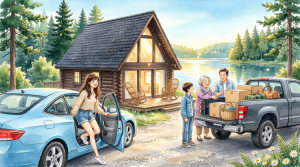
When I left that weekend, my mother was watering the herbs, my father was in his chair on the porch facing the lake, and the house behind them looked steady and quiet and fully itself.
That was the ending I had wanted all along.
Not revenge.
Not drama.
Just safety that held.
And at last, it did.

